When Should You Do the Golden Triangle Nepal & Mardi Himal Trek?
Timing is everything when it comes to Himalayan trekking.
Best Weather Windows for the Golden Triangle & Mardi Himal
Nepal has two primary trekking seasons:
Spring (March – May): This is arguably the finest season for the Mardi Himal Trek. The rhododendron forests are in full bloom, and explosions of red, pink, and white flowers line the trail. Temperatures are warming up, visibility is generally excellent before the pre-monsoon haze thickens, and the mountains look majestic against clear blue skies. Late April and early May (exactly when this itinerary runs) offer the perfect combination of warm temperatures at lower elevations and manageable cold at altitude.
Autumn (October – November): Post-monsoon clarity makes autumn a runner-up. The skies are crystal clear, trails are freshly washed, and temperatures are crisp and energizing. If you can't travel in spring, October or November is your next best option.
Month-by-Month Weather Breakdown
Month | Temperature at High Camp (~3,550m) | Conditions |
March | 0°C to 10°C | Clear, cold |
April | 5°C to 14°C | Excellent, blooming |
May | 8°C to 16°C | Warm, some haze |
June–Sept | 10°C to 18°C | Monsoon, wet, leeches |
October | 2°C to 12°C | Perfect clarity |
November | -3°C to 8°C | Cold but clear |
Dec–Feb | -10°C to 0°C | Snow, icy trails |
Food and Beverages: What to Expect on the Trail
One of the most common questions trekkers ask is: "What will I eat on the Mardi Himal Trek?" The answer is: more than you'd expect, and better than you'd imagine.
Dal Bhat: The cornerstone of every Nepali trekker's diet. A hearty plate of lentil soup, steamed rice, vegetable curry, and pickled condiments refillable at most teahouses is your best friend on the trail. It's nutritious, filling, and surprisingly delicious after a 6-hour hike.
Trekker Menu Staples: Tea house menus along the Mardi Himal route typically offer:
- Tibetan bread with honey or jam
- Pasta and noodle soups
- Fried rice and fried noodles (chow mein)
- Momos (Nepali dumplings) are a must-try
- Porridge and pancakes for breakfast
- Garlic soup (excellent for altitude acclimatisation)
- Spring rolls and steamed vegetables
Beverages: Expect plenty of hot lemon tea, ginger tea, black tea, and Nepali milk tea. Bottled water is available but can be pricey at altitude; consider bringing purification tablets or a filter bottle. Hot drinks are strongly recommended at High Camp to stay warm and hydrated.
In Kathmandu and Pokhara, both cities have vibrant food scenes. You'll find everything from authentic Newari cuisine to Italian pasta, Japanese ramen, Israeli hummus, and American breakfast plates. Thamel in Kathmandu and Lakeside in Pokhara are packed with great restaurants for every budget.
In Chitwan, Resorts and lodges typically serve buffet-style meals featuring Nepali and Indian-inspired cuisine. Fresh vegetables, curries, rice, and locally sourced proteins are common.
Important Note on Altitude: At higher elevations (above 3,000 meters), your appetite may decrease due to altitude. Eat small, frequent meals, stay hydrated, and avoid heavy proteins that are harder to digest.
Accommodation During Chitwan Mardi Trek: Comfort at Every Altitude
The Golden Triangle of Nepal & Mardi Himal Trek offers accommodation that suits every stage of the journey:
Kathmandu (Days 1–3): You'll be staying at a comfortable hotel in or near the Thamel district, Kathmandu's vibrant tourist hub. Hotels in this range typically offer en-suite bathrooms, hot water, Wi-Fi, and breakfast. Expect 3-star equivalent comfort.
Mardi Himal Trek (Days 4–8) Tea Houses: Tea houses along the Mardi Himal route are basic but functional. Here's what to expect:
Feature | Availability |
Twin/Double Rooms | Available |
Shared Bathrooms | Standard at all camps |
Hot Shower | Available at some camps (solar-heated, extra charge) |
Blankets & Pillows | Provided |
Electricity / Charging | Available (small fee at some lodges) |
Wi-Fi | Limited/unreliable above Forest Camp |
Heating | Limited, bring a good sleeping bag |
Bring a sleeping bag rated to at least -10°C for High Camp nights (3,550m). Even in late April and early May, temperatures drop sharply after sunset.
Pokhara (Days 4 & 8): Hotels in Pokhara's Lakeside area offer excellent comfort with views of Phewa Lake and the Annapurna range. Expect 3-star amenities, rooftop restaurants, and a relaxed atmosphere.
Chitwan (Days 9–10): Chitwan typically features jungle-style lodge or resort accommodation. Many properties here are designed to blend with the natural environment, offering comfortable rooms, open-air dining areas, and guided wildlife walks right from your doorstep.
Permits You Need Before Mardi Himal Trek with All Nepal Tour
Navigating Nepal's permit system can be confusing for first-timers, so here's a clear breakdown of everything you'll need for the Golden Triangle of Nepal & Mardi Himal Trek:
Permit | Cost (Approx.) | Where to Get It |
|---|
Annapurna Conservation Area Permit (ACAP) | NPR 3,000 (~USD 23) | TIMS offices, Pokhara or Kathmandu |
|---|
TIMS Card (Trekkers' Information Management System) | NPR 2,000 (~USD 15) | Nepal Tourism Board offices |
|---|
Mardi Himal Entry Fee | Included in ACAP | — |
|---|
Chitwan National Park Entry | NPR 1,500 (~USD 11) per day | At the park gate |
Nepal Tourist Visa | USD 30 (15 days) / USD 50 (30 days) | On arrival or online |
Pro Tips on Permits:
- Carry 4 passport-size photos; they're required for several permits.
- Keep all permits accessible at all times; there are checkpoints along the Mardi Himal trail.
- Your trekking agency or guide can arrange most permits on your behalf in Pokhara before the trek begins.
10 Critical Things to Remember Before Mardi Trek
Before you lace up your boots, here are 10 absolutely essential things to keep in mind:
- Start fitness training at least 4–6 weeks before departure. Daily walks, stair climbing, and cardio will make a huge difference at altitude.
- Pack light but smart. Your porter will carry your main duffel bag (usually up to 10kg included). Keep a daypack with essentials: water, snacks, rain gear, a camera, and first aid.
- Altitude sickness is real. The Mardi Himal viewpoint sits at 4,200m. Know the symptoms of AMS (headache, nausea, dizziness, fatigue) and never ascend if you feel unwell. Acclimatise properly.
- Travel insurance is non-negotiable. Ensure your policy covers high-altitude trekking (above 4,000m) and helicopter evacuation if necessary.
- Download offline maps. Apps like Maps.me or Gaia GPS are invaluable when you're out of signal range. Download the Annapurna region maps before departure.
- Respect local culture. Dress modestly at religious sites, remove shoes before entering temples, ask permission before photographing locals, and always walk clockwise around stupas and mani walls.
- Bring cash. ATMs are available in Kathmandu and Pokhara, but are largely nonexistent along the trekking route. Carry sufficient Nepali rupees.
- Layer your clothing. The temperature swing between Kathmandu (35°C in May) and Mardi Himal High Camp (near 0°C at night) is enormous. Pack moisture-wicking base layers, fleece mid-layers, and a quality down jacket.
- Stay hydrated. Drink at least 3–4 litres of water per day on trekking days, especially above 3,000m. Avoid alcohol at altitude.
- Hire a licensed guide. Not only does it support the local economy, but a knowledgeable guide also enhances your experience dramatically. They know the trails, the culture, and the history, and can respond to emergencies.
Useful Information
This 12-day trek spans an impressive range of elevations, cultures, and ecosystems, making it one of Nepal's most well-rounded adventure packages available today. The trip runs at a moderate difficulty level, suitable for reasonably fit adults and children aged 12 and above, with a maximum altitude of 4,200m at the Mardi Himal Viewpoint and a minimum of just 415m in the steamy lowlands of Chitwan. Nepal operates on Nepal Standard Time (UTC +5:45), uses the Nepali Rupee (NPR) as its currency, and runs on 230V electricity with Type C and D plug sockets that carry a universal adapter. The internet is widely available in Kathmandu and Pokhara, becomes patchy above Forest Camp on the trek, and is largely unavailable at High Camp, so download offline maps and notify family of your itinerary in advance.
The best months to undertake this specific journey are April and May (spring) or October and November (autumn), with this itinerary's late April to early May window being particularly magical due to blooming rhododendrons and excellent pre-monsoon visibility. Emergency services in Nepal include the Tourist Police helpline at 1144, the general police at 100, and ambulance services at 102. Helicopter evacuation from the Mardi Himal Trek is available but requires comprehensive travel insurance that explicitly covers high-altitude trekking above 4,000m and emergency evacuation costs, which can reach USD 3,000–5,000 without coverage.
Altitude & Elevation Profile
The elevation journey of this trek is one of its most dramatic and rewarding characteristics, taking you from Kathmandu at 1,400m through the medieval streets of Bhaktapur (1,401m) and down to the lake-level comfort of Pokhara at 827m before the real climb begins. From the trailhead at Kande (1,770m), you ascend steadily through subtropical forest to Deurali (2,100m) on Day 4, push higher to Low Camp (2,985m) on Day 5 with an impressive single-day gain of 885 meters, continue to High Camp (3,550m) on Day 6, and then make the bold early-morning summit push to the Mardi Himal Viewpoint at approximately 4,200m on Day 7, the highest point of the entire journey and one of the finest mountain panoramas in the entire Annapurna region.
After the euphoria of the viewpoint, you descend all the way back to Low Camp on Day 7 afternoon, then complete the full descent through Sidding village to Pokhara on Day 8, dropping over 2,100 vertical meters in a single day, which is hard on the knees but liberating for the spirit. The journey then dips to its lowest point in Chitwan at just 415m above sea level, a dramatic contrast from the icy Himalayan ridgelines of just days before, before a final return to Kathmandu at 1,400m completes a beautifully varied elevation journey that takes your body through five distinct climate and ecosystem zones in under two weeks.
Distance
The total trekking distance across the five active trek days covers approximately 42 kilometers from Kande trailhead to Sidding village, with daily distances ranging from 5km on the shorter High Camp day to 12km on the demanding Day 7 round trip to the viewpoint and back down to Low Camp. Daily trekking durations typically run between 4 and 7 hours of actual walking time, not including rest stops, photography breaks, and tea house pauses, making this a moderately paced trek that rewards those who take their time and absorb the scenery rather than racing through it.
Beyond the trekking section, the non-trekking travel distances add significant ground covered: the Pokhara to Kande trailhead drive is 22km (~45 minutes), the Sidding to Pokhara return transfer covers 35km (~1.5 hours on winding roads), and the domestic flights from Pokhara to Bharatpur (110km, 20 minutes) and Bharatpur to Kathmandu (160km, 25 minutes) make the overall journey seamlessly connected. In total, factoring in all road, air, and foot travel, the Golden Triangle & Mardi Himal Trek moves you across well over 600 kilometers of stunning Nepali terrain from high Himalayan ridges to ancient city streets to subtropical jungle floors.
Major Highlight Spots
The cultural crown jewels of this journey are concentrated in Kathmandu and Bhaktapur Boudhanath Stupa, one of the world's largest Buddhist stupas and a living hub of Tibetan spiritual life, where monks complete dawn circumambulations in a cloud of butter lamp smoke and incense; Pashupatinath Temple, Asia's holiest Hindu site where ancient cremation rituals unfold beside the sacred Bagmati River; and Bhaktapur Durbar Square, a UNESCO-listed medieval Newari city where the 55-Window Palace, the towering Nyatapola Pagoda, and traditional pottery squares have remained largely unchanged for six centuries. Pokhara's Phewa Lake, with the Annapurna range perfectly mirrored on its still surface at dawn, serves as both a serene rest stop and one of Nepal's most photographed natural spectacles.
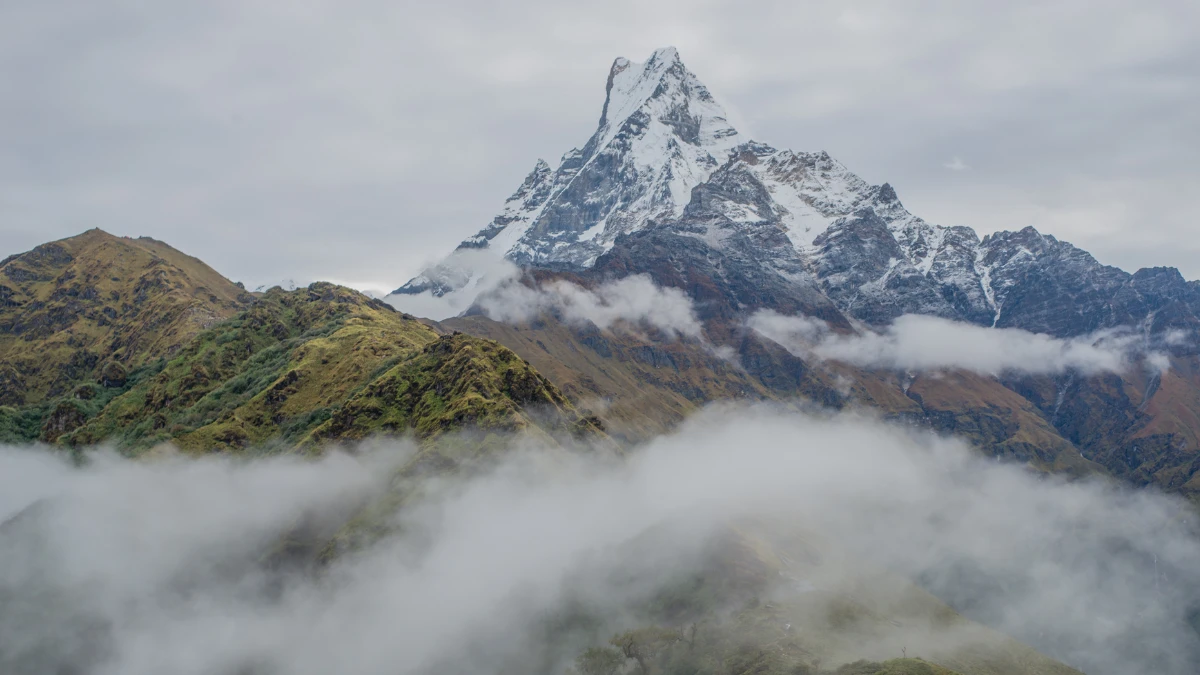
On the trek itself, the most unforgettable highlights are the explosion of crimson and white rhododendron blooms between Deurali and Low Camp (April's greatest gift to trekkers), the commanding 360-degree Himalayan panorama that opens up from the Low Camp ridge, the intimate proximity of Machhapuchhre (Fishtail Peak, 6,993m) as you ascend toward High Camp, and the absolute silence of the 4,200m Mardi Himal Viewpoint, where Annapurna South, Hiunchuli, and Mardi Himal itself frame a mountain scene that rivals anything on the more famous Annapurna Circuit. Chitwan rounds it all out with the iconic sight of endangered one-horned rhinoceroses grazing in tall grassland, Royal Bengal tiger tracks crossing dusty jeep trails, and hundreds of bird species filling the riverine forest with extraordinary sound and color.
Where Is Mardi Himal?
Mardi Himal (5,587m / 18,330 feet) is a magnificent Himalayan peak located in the Annapurna Massif of Gandaki Province in central Nepal, sitting on the eastern ridge of the Annapurna Sanctuary approximately 30 kilometers northeast of Pokhara and roughly 200 kilometers west of Kathmandu. It forms part of a stunning cluster of peaks that includes its famous neighbors, Machhapuchhre (Fishtail, 6,993m) to the northwest, Annapurna South (7,219m) to the west, and Hiunchuli (6,441m), all of which become increasingly dramatic and close-feeling as you ascend the Mardi Himal Trek's southeastern ridge toward the 4,200m viewpoint.
The Mardi Himal trekking route was officially opened and promoted by the Nepal Tourism Board in 2012 as a less-trafficked alternative to the heavily visited Annapurna Base Camp and Poon Hill trails, and it sits entirely within the Annapurna Conservation Area (ACAP), Nepal's largest protected area covering 7,629 square kilometers. The entire route from the Kande trailhead (1,770m) to the summit viewpoint (4,200m) follows the southeastern ridge of the mountain through dense subtropical forest, open rhododendron meadows, and exposed high-altitude terrain, making it a geographically stunning and ecologically diverse trek that rewards every step with increasingly spectacular Himalayan scenery.
Transportation
Transportation throughout this 12-day journey is handled entirely by a smooth combination of private vehicles, domestic flights, and specialist safari transport, all coordinated so you never have to worry about a single connection. In Kathmandu, all sightseeing is done by private vehicle with your licensed guide, covering the airport transfer on arrival, the city tour to Boudhanath and Pashupatinath, and the morning excursion to Bhaktapur before heading to Pokhara either by a scenic 30-minute domestic flight (recommended for speed and the stunning aerial views of the Himalayan foothills) or a 6–7 hour drive along the Prithvi Highway through river gorges and terraced hillsides. From Pokhara, a private jeep covers the 22km drive to the Kande trailhead in approximately 45 minutes, and another vehicle meets you at Sidding village after the trek for the 1.5-hour return to Pokhara on winding mountain roads.
The Chitwan leg is accessed by a spectacular 20-minute domestic flight from Pokhara to Bharatpur Airport, the most scenic domestic route in Nepal, with the entire Annapurna range visible on clear mornings, followed by a lodge transfer to your jungle resort. Within Chitwan, open-top 4WD jeeps handle the game drives, traditional dugout canoes navigate the Rapti River for bird watching, and guided walks take you through the buffer zone on foot with a trained naturalist. The return to Kathmandu from Bharatpur is a quick 25-minute domestic flight, and your final journey is a private vehicle transfer from your hotel to Tribhuvan International Airport departing at 05:30 AM on Day 12.
Safety & Preparation
The most critical safety consideration on the Mardi Himal Trek is Acute Mountain Sickness (AMS), which can affect anyone above 3,000 meters regardless of fitness level. Symptoms to watch for include a persistent headache unresponsive to paracetamol, nausea, dizziness, unusual fatigue, and loss of appetite, and the golden rule is simple: if symptoms worsen, descend immediately and never ascend while unwell. Prevention starts weeks before departure with a solid cardio training program (daily walking, stair climbing, and loaded pack hikes for 4–6 weeks), continues on the trail with slow and steady ascents, drinking 3–4 liters of water daily, eating altitude-friendly foods like garlic soup, avoiding alcohol above 3,000m, and ideally consulting your doctor about Diamox (acetazolamide) as a prophylactic medication. Travel insurance that explicitly covers high-altitude trekking above 4,000m and helicopter evacuation is absolutely non-negotiable; without it, an emergency evacuation from High Camp could cost you USD 3,000–5,000 out of pocket.
Beyond altitude, general trail safety requires always trekking with a licensed government-registered guide, starting each day early to avoid afternoon cloud cover and reduced visibility, carrying a fully stocked daypack with first aid essentials, and sharing your daily itinerary plans with your guide each morning. In Chitwan, always follow your naturalist guide's instructions without exception during safaris. Rhinos are territorial and can charge without warning, so maintaining safe distances and staying calm during wildlife encounters is essential. Keep printed and digital copies of your passport, visa, all permits, insurance documents, and emergency contacts on your person at all times throughout the trip, and save the Nepal Tourist Police number (1144) and your country's embassy contact in Kathmandu in your phone before you depart home.
 based on 251 reviews