based on 270 reviews

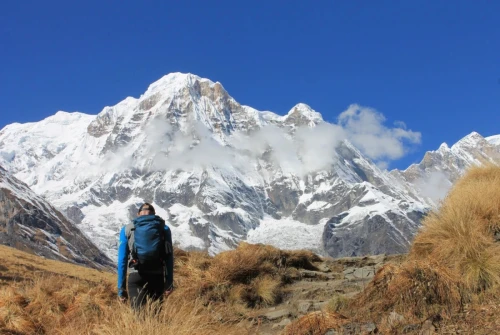
Mount Everest, the world’s tallest mountain, rises as the crown jewel of the Mahalangur Himal sub-range in the Asian Himalayas, straddling the border between Nepal and Tibet. Standing at a staggering height of 8,848.86 meters (29,031.7 feet) above sea level, Everest attracts a diverse array of adventurers, trekkers, and climbers from every corner of the globe.
Every year, thousands of trekkers make the pilgrimage to Everest Base Camp, with many seeking to explore the mountain’s majestic landscape. For those seeking the ultimate challenge, climbers attempt to summit Mount Everest, facing one of the most difficult and dangerous climbs in the world.
More than just the highest peak on Earth, Mount Everest symbolizes human endurance, ambition, and the ultimate test of adventure. Whether you're planning a trek to Everest Base Camp, or dreaming of summiting Everest, understanding the geography, history, and challenges of this monumental peak is essential to truly appreciating its magnificence.
Mount Everest The Ultimate Guide to the World's Highest Peak
What is Mount Everest?
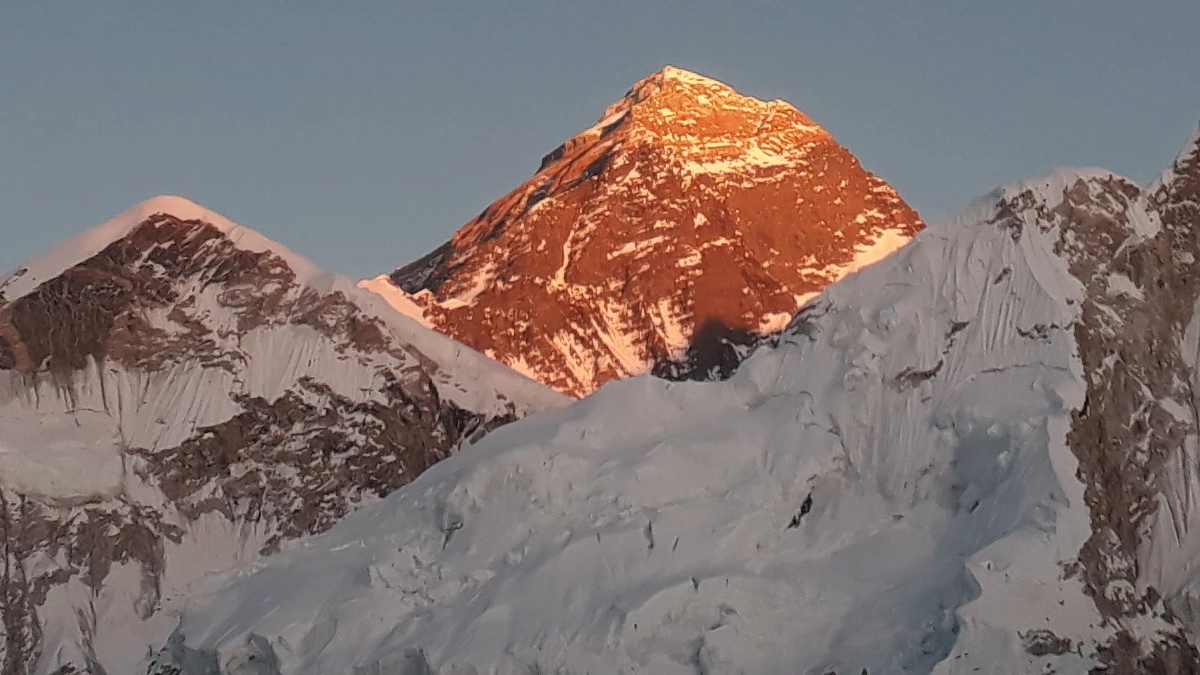
Mount Everest, Also known as Sagarmatha in Nepali and Chomolungma in Tibetan, is the highest peak on Earth, standing at a staggering 8,848.86 meters (29,031.7 feet) above sea level. This mountain is part of the Himalayan range and is located in the Mahalangur Himal sub-range. Mount Everest straddles the border between Nepal and Tibet, making it one of the most sought-after and famous destinations for adventurers, trekkers, and climbers worldwide.
Everest's peak represents the ultimate challenge in mountain climbing and attracts those with a passion for high-altitude expeditions, extreme mountaineering, and global adventure. Mount Everest's elevation, cultural significance, and physical presence make it a natural wonder and a true test of human endurance.
Where is Mount Everest?
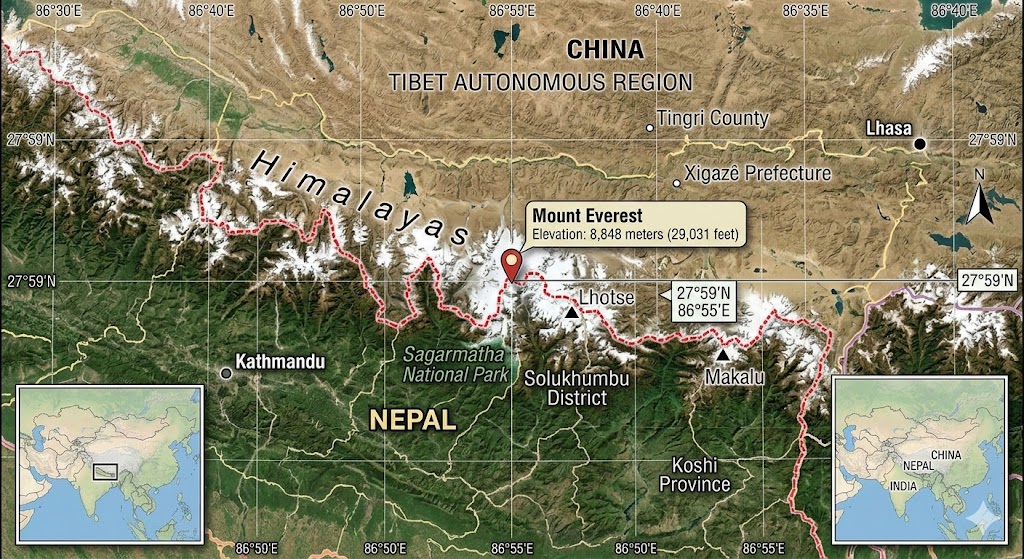
Everest, the tallest mountain in the world, is located on the border between Nepal and China Tibet, in the Himalayas of Asia. It is part of the Mahalangur Himalayan range, a sub-range of the greater Himalayas. Everest's summit marks the boundary between Nepal to the south and Tibet (an autonomous region of China) to the north.
Nepal Side Sagarmatha National Park
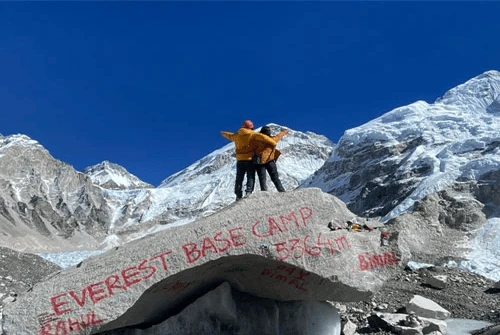
On the Nepal side, Everest Himalayas is located within Sagarmatha National Park in the Solukhumbu District. The south face of Everest, which is the most famous and accessible route for trekkers, is found here. The South Everest Base Camp, located at 5,364 meters (17,598 feet), is the starting point for climbers attempting to summit from the south side.
Everest Base Camp (South) is accessible via a 10-12 day trek from Lukla, passing through villages like Namche Bazaar and Gorak Shep before reaching the iconic base camp.
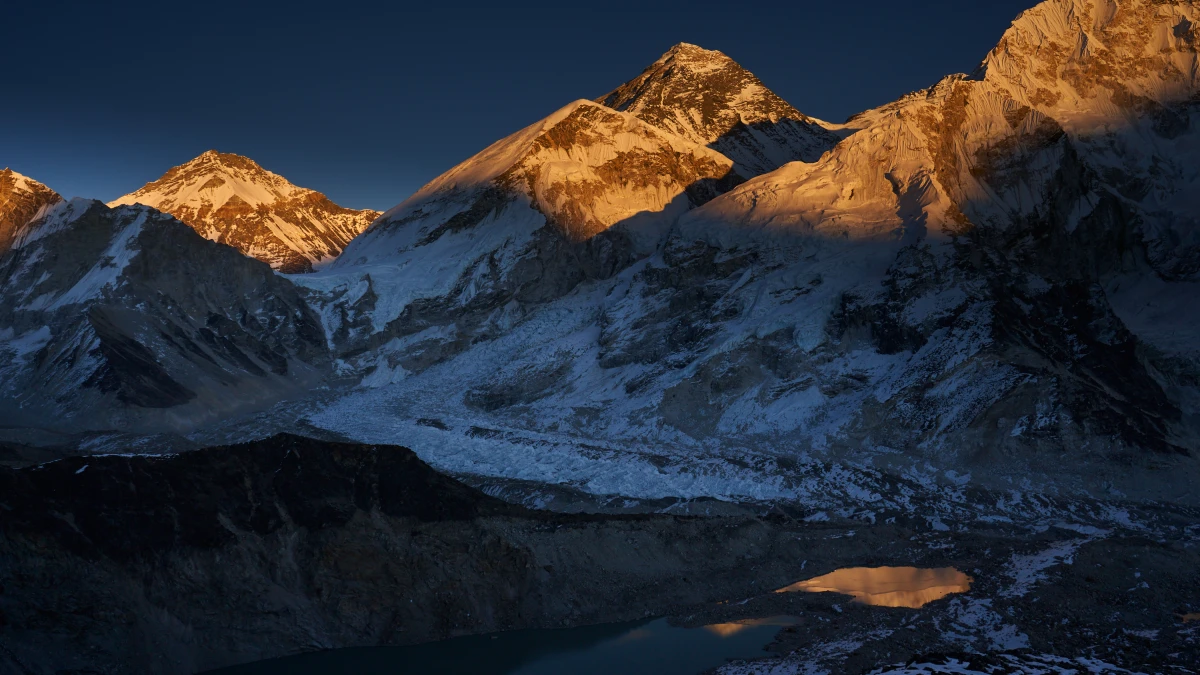
Kalapathar, a famous viewpoint near Gorak Shep, offers breathtaking views of the summit and is often a highlight for trekkers.
Tibet Side Rongbuk and Tingri
On the Tibet side, Mount Everest is located in Tingri, within the Shigatse Area. The north face of Everest lies in Tibet, offering a different perspective of the mountain. The Everest North Base Camp, located at 5,200 meters (17,060 feet), is accessible by car or jeep, making it a more easily reachable location than the Nepalese south side.
Rongbuk Monastery, located near the North Base Camp, is the highest monastery in the world and offers a striking view of Everest’s north face.
Tibet’s Everest Base Camp is known for its rugged landscape, less crowded conditions, and dramatic scenery.
The South Base Camp is the most popular starting point for trekkers visiting Everest, while the North Base Camp is primarily accessed by travelers seeking a more remote,vehicle-accessible route.
Names and Cultural Significance of Mount Everest
Mount Everest, the world’s tallest mountain, is known by various names across different cultures, each reflecting its spiritual, cultural, and geographical importance.
Chomolungma (Tibetan)
In Tibetan, Mount Everest is called Chomolungma, which translates to "Goddess Mother of the World." The name reflects the reverence and respect the Tibetan people have for the mountain, viewing it as a divine figure and a mother figure who protects the region. Everest’s towering presence in the Himalayas has deep spiritual significance, and for the people of Tibet, it is a symbol of the divine power that governs the natural world.
Sagarmatha (Nepali)
In Nepal, Mount Everest is called Sagarmatha, meaning "Goddess of the Sky." The Nepali name highlights Everest's celestial connection, signifying the peak’s sacredness to the people of the Khumbu region and the Sherpa community. The Sherpas, who are the ethnic group most associated with the Everest region, regard the mountain as a deity that watches over their lives and provides both protection and strength.
Mount Everest (Western Name)
The Western name, Mount Everest, was given to the mountain in honor of Sir George Everest, a British Surveyor General of India in the 19th century. Everest's contributions to the surveying of the Indian subcontinent led to the mountain being named after him, despite the fact that Everest himself had never seen the peak. The name has become globally recognized, cementing its place in both mountaineering history and popular culture.
Spiritual Significance and Reverence
Mount Everest holds a deep spiritual significance in the cultures of both Nepal and Tibet. For the Sherpa community in Nepal, Everest is not just a mountain but a sacred deity that embodies strength, endurance, and resilience. It plays a key role in their religious practices and is revered as a protector and source of power. Many Sherpas believe that Everest is a powerful and living spirit, guiding climbers and trekkers through the harsh conditions of the region.
In Tibetan culture, Everest is similarly seen as a divine presence. Pilgrims from Tibet and beyond visit the Rongbuk Monastery, located near the north base camp, to offer prayers and seek blessings before embarking on their journey to the peak. The spiritual importance of Everest has led to local traditions, rituals, and festivals that honor the mountain as a manifestation of the divine.
The History About Mount Everest
Mount Everest has a rich and fascinating history, marked by daring expeditions, legendary climbers, and monumental achievements. The history of Everest is a story of exploration, endurance, and the unyielding human spirit in the face of one of the harshest environments on Earth.
19th Century: The Discovery of Mount Everest
In the early 19th century, Mount Everest was known to locals but was largely unexplored by the Western world. It was first identified by the Great Trigonometric Survey of India led by Sir George Everest, the British Surveyor General of India. The survey aimed to map the entire Indian subcontinent, and it was during this process that Everest was first recognized as the highest peak in the world. In 1865, the mountain was officially named Mount Everest in honor of Sir George Everest, despite the fact that he had never seen the peak himself.
1924: The Mallory-Irvine Mystery
In 1924, two British climbers, George Mallory and Andrew Irvine, attempted to summit Everest for the first time. They were last seen near the final ridge of the mountain, but they mysteriously disappeared before their fate could be confirmed. To this day, it remains uncertain whether Mallory and Irvine reached the summit of Everest before they perished in the harsh conditions. The Mallory-Irvine mystery has been one of the most enduring and intriguing questions in mountaineering history. Mallory's body was discovered in 1999, but the question of whether they reached the summit remains unanswered.
1953: The First Successful Ascent
The first successful summit of Mount Everest was achieved on May 29, 1953, by Sir Edmund Hillary from New Zealand and Tenzing Norgay from Nepal. Their successful climb is one of the greatest milestones in the history of mountaineering. The achievement was a result of years of preparation and multiple expeditions by various countries to conquer the peak. Hillary and Norgay’s accomplishment was celebrated worldwide, marking the culmination of a goal that had eluded so many before them. Their success not only made history but also established Everest as the ultimate mountaineering challenge.
How Tall is Mount Everest?
Mount Everest stands as the tallest mountain on Earth, with an official elevation of 8,848.86 meters (29,031.7 feet) above sea level, as measured in 2020. This staggering height makes Everest the highest point on the planet, towering above all other mountains.
The summit of Mount Everest is often referred to as the Death Zone. This term reflects the extreme conditions climbers face above 8,000 meters (26,247 feet), where the air contains only about a third of the oxygen found at sea level. In this zone, the human body begins to deteriorate due to the lack of oxygen, making survival extremely difficult without supplemental oxygen. Climbers also battle freezing temperatures, high winds, and the physical toll of the altitude, making the ascent a dangerous and challenging feat.
Everest’s height and the harsh conditions at its summit make it a symbol of human perseverance and the ultimate mountaineering challenge.
Everest Base Camp
Everest Base Camp is one of the most iconic destinations in the world for trekkers and adventurers seeking to experience the majesty of Mount Everest up close. At an elevation of 5,364 meters (17,598 feet), EBC serves as the starting point for those attempting to summit Everest. However, for most trekkers, the journey to Base Camp itself is a life-changing adventure, offering a unique glimpse into the world of high-altitude trekking and Sherpa culture.
The trek to Everest Base Camp typically takes 10-12 days and starts with a flight from Kathmandu to Lukla, a small airport in the Khumbu region. From Lukla, trekkers follow a well-established route that passes through Namche Bazaar, the bustling Sherpa hub, and continues through breathtaking landscapes, including the famous Khumbu Icefall and views of Lhotse and other towering peaks.
Highlights of the EBC Trek:
Khumbu Icefall: A stunning and treacherous ice formation that climbers must pass through to reach the summit.
Lhotse and other peaks: Stunning views of the world’s 4th tallest mountain, Lhotse, as well as other towering peaks like Nuptse and Ama Dablam.
Sherpa Culture: An opportunity to learn about the traditions, lifestyle, and customs of the Sherpa people, who are integral to Everest expeditions.
Namche Bazaar: The vibrant Sherpa market town, which serves as a key acclimatization stop for trekkers on their way to EBC.
The trek to Everest Base Camp is a rewarding journey, providing trekkers with breathtaking views of the Himalayas, close encounters with Sherpa culture, and a deeper understanding of the challenges faced by those who climb the world’s tallest mountain. It’s the perfect way to experience Mount Everest without the risks of summit climbing.
Mt.Everest Climbing Route
Climbing Mount Everest is a major undertaking, and there are several established routes, with the two most commonly used being the South Col route from Nepal and the North Col route from Tibet (China).
South Col Route (Nepal)
This is the most popular expedition route and the one most climbers attempt. It involves a combination of trekking, technical climbing, and high-altitude mountaineering.
Stages of the South Col Route:
Base Camp: The journey starts with a trek to Everest Base Camp (5,380 meters / 17,600 feet), which can be reached via a 10-14 day trek from Lukla, Nepal.
Khumbu Icefall: After Base Camp, climbers ascend the Khumbu Icefall, a dangerous section of moving ice and crevasses.
Camp I (6,065 meters / 19,900 feet): Located on the Western Lhotse Face, Camp I is accessed after crossing the icefall. It's typically the first true high-altitude camp.
Camp II (6,400 meters / 21,000 feet): Located on the Lhotse Wall, this is where climbers prepare for their summit push.
Camp III (7,470 meters / 24,500 feet): Camp III is located on the Lhotse Face. It’s a steep section, requiring fixed ropes and technical climbing.
Camp IV (7,920 meters / 26,000 feet): Situated just below the South Col, this camp is the last stop before summiting.
Summit Push (8,848 meters / 29,029 feet): The final stretch involves navigating the South Summit, Hillary Step (a difficult rock section), and then reaching the true summit at the top of the world.
Climbers typically spend about 6-8 weeks in the Everest region, acclimatizing at higher altitudes and waiting for a weather window to summit.
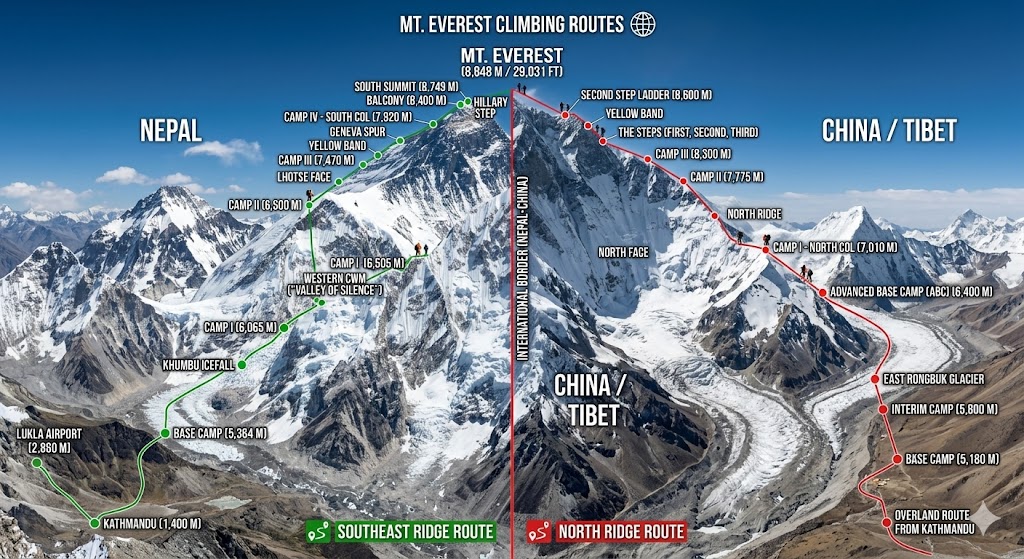
North Col Route (Tibet/China)
This route starts from the Tibetan side of Everest and is less crowded, though still very challenging. The approach is different, and the terrain is distinct.
Stages of the North Col Route:
Base Camp (Tibet) (5,150 meters / 16,900 feet): Accessed via the Tibetan Plateau, Base Camp on the north side is lower than Nepal's, but the altitude can still be challenging.
North Col (7,000 meters / 23,000 feet): This is the key camp on the north side. Climbers ascend a glacier and steep sections of rock to reach the North Col.
Camp II (7,700 meters / 25,300 feet): Located above the North Col, this is a staging point for the summit push.
Summit Push: From Camp II, climbers ascend the North Ridge, dealing with sections of mixed rock and ice. The summit is reached via a steep, technical climb.
The North Col route is known for its harsher weather conditions and less supportive infrastructure (e.g., fewer Sherpas and support facilities). It’s also a more technically demanding route.
The Best Time to Visit Mount Everest
When planning a visit to Mount Everest, choosing the right season can make a significant difference in the experience. The best times to visit Mount Everest are during the spring (March–May) and autumn (September–November) seasons. These months offer the most favorable conditions for both trekking and climbing, with clear skies, mild temperatures, and minimal snowfall, ensuring the safety and enjoyment of adventurers.
Spring (March–May) Perfect for Climbing Expeditions
The spring season is the most popular time for climbers attempting to summit Mount Everest. During these months, the weather is relatively stable, with clear skies and mild temperatures, making it ideal for high-altitude expeditions. This period allows climbers to face less snow accumulation and more predictable weather conditions. The spring season also provides the best opportunities for acclimatization during the trek to Everest Base Camp.
Advantages:
Stable weather with clear skies and good visibility.
Ideal for summiting Mount Everest.
Mild temperatures for both trekking and climbing.
Higher number of climbers attempting the summit, so support and logistics are readily available.
Autumn (September–November) Ideal for Trekking
The autumn season is perfect for those looking to trek to Everest Base Camp or explore the surrounding region. The weather is cool and dry, with crisp blue skies, making for a comfortable trekking experience. Though it is a bit colder than spring, the weather is still much milder than in the winter months. Autumn also offers beautiful scenery, with the clear skies providing stunning views of Everest and other Himalayan peaks.
Advantages:
Cooler, dry weather ideal for trekking.
Fewer crowds compared to spring, making for a more peaceful trek.
Ideal for experiencing the Khumbu region and Sherpa culture.
Good visibility and stunning mountain vistas.
Challenges of Climbing Mount Everest
Climbing Mount Everest is considered one of the ultimate tests of human endurance and skill. The challenges climbers face are numerous and often life-threatening, making it a dangerous and difficult pursuit. From extreme weather to technical obstacles, the mountain demands meticulous planning, strength, and perseverance.
Altitude Sickness
One of the most significant challenges of climbing Mount Everest is the altitude. As climbers ascend higher, the oxygen levels in the air decrease, which can lead to altitude sickness. Symptoms include headaches, dizziness, nausea, and in severe cases, cerebral or pulmonary edema. Proper acclimatization is essential to mitigate the risks of altitude sickness, but even with careful planning, the danger remains.
Extreme Temperatures
At higher altitudes, especially above 8,000 meters (26,247 feet), temperatures can plummet to -40°C (-40°F) or lower, making it extremely difficult to survive without the right gear. Even in the lower regions of the mountain, the temperatures can be harsh, and frostbite is a constant threat to climbers exposed to the extreme cold for extended periods.
Unpredictable Weather
The weather on Everest is notoriously unpredictable, with high winds, snowstorms, and sudden temperature changes. These weather conditions can cause dangerous avalanches, poor visibility, and an increased risk of accidents. Climbing Everest requires constant vigilance and the ability to adapt quickly to changing conditions.
Avalanches and Icefalls
Climbers face the threat of avalanches, especially in the Khumbu Icefall and the Western Cwm. The Khumbu Icefall is particularly dangerous due to shifting ice blocks, crevasses, and unstable snow. Climbers must navigate this area early in the morning before the sun melts the ice and increases the risk of avalanches. In addition, climbers must deal with seracs (huge blocks of ice), which can collapse unexpectedly, posing a deadly risk.
Technical Challenges
The route to the summit of Mount Everest requires climbers to navigate technical challenges such as steep rock faces, ice walls, and deep crevasses. In some sections, climbers must use fixed ropes and ladders to cross crevasses and ascend vertical rock faces. These obstacles require technical climbing skills and the use of specialized equipment, including ice axes, crampons, and ropes.
The Death Zone on Mt.Everest
The most dangerous aspect of climbing Mount Everest is the Death Zone, which begins at 8,000 meters (26,247 feet). In this zone, the air contains only about one-third of the oxygen available at sea level, making breathing incredibly difficult. Climbers experience extreme fatigue, hallucinations, and physical deterioration due to the lack of oxygen. Even with supplemental oxygen tanks, survival is a constant battle against the body’s deteriorating condition.
Survival in the Death Zone requires careful use of oxygen tanks, frequent rest, and extreme caution. This area has earned its ominous name because of the high fatality rate among climbers who attempt to summit without sufficient preparation or experience.
Risks of the Death Zone:
Severe Oxygen Deprivation: The lack of oxygen can cause confusion, exhaustion, and even death.
Increased Risk of Frostbite: The cold combined with low oxygen can result in quick tissue damage.
Physical and Mental Fatigue: Climbers are physically drained, and the reduced oxygen levels impair mental clarity, making decision-making even more difficult.
Extended Exposure to Harsh Conditions: Climbers are at high altitudes for extended periods, which increases the chances of developing fatal conditions such as high-altitude pulmonary edema (HAPE) or high-altitude cerebral edema (HACE).
Other Dangers
Falling Rocks: Mount Everest is prone to rockfalls, especially in sections like the Hillary Step and near the South Col.
Crowds and Delays: In recent years, overcrowding at the summit has become a growing concern, leading to delays, increased risk of accidents, and higher stress on climbers in the Death Zone.
Limited Time: Climbers have a limited window for summiting during favorable weather conditions, making it crucial to time the ascent and descent perfectly.
Accommodation on the Mount Everest Trek
During the trek to Everest Base Camp, trekkers have a variety of accommodation options that cater to different comfort levels, ranging from cozy tea houses to basic lodges. While the lower altitudes offer more comfortable and modern options, as trekkers ascend to higher altitudes, the accommodations become simpler. However, the views of Mount Everest and the surrounding Himalayan peaks make up for the simplicity.
Tea Houses and Lodges on the Everest Trek
The trek to Everest Base Camp is primarily supported by tea houses and lodges, which are small, family-run guesthouses along the trekking route. These places offer basic rooms, meals, and a warm place to rest after a long day of trekking. Staying in these tea houses allows trekkers to experience the local Sherpa culture and hospitality, while also providing an essential way to acclimatize to the increasing altitude.
Hotel Everest View
Hotel Everest View is one of the most famous accommodations along the trek. Located in Syangboche, this luxury hotel offers stunning panoramic views of Mount Everest and surrounding peaks like Lhotse and Ama Dablam. Known for its breathtaking vistas, this hotel is a popular stop for trekkers before heading further up to Everest Base Camp.
Panorama Lodge and Restaurant:
This charming lodge, located in Tengboche, is known for its welcoming atmosphere and incredible views of Mount Everest and Lhotse. The Panorama Lodge offers a cozy resting place for trekkers as they make their way through the Khumbu region.
Namche Terrace:
In the bustling town of Namche Bazaar, trekkers can find comfortable accommodation at Namche Terrace, a lodge that provides a great place to rest while acclimatizing. Namche Bazaar is a vibrant Sherpa hub, and the Namche Terrace offers spectacular views of Mount Everest and its surrounding peaks, providing trekkers with both comfort and convenience.
Beyond Base Camp – High-Altitude Camps
Once trekkers reach Everest Base Camp, the accommodation options become much more basic. Climbers attempting to summit Mount Everest must set up high-altitude camps along the southern route, where the conditions are harsh and the weather is unpredictable. The camps are strategically placed at high points on the mountain to aid in acclimatization and facilitate safe ascents.
Camp I, Camp II, and Camp III
Beyond Base Camp, the only accommodation available is camping at high-altitude points like Camp I (6,065 meters), Camp II (6,400 meters), and Camp III (7,162 meters) along the South Col route. These camps offer shelter and protection from the elements, but climbers face extreme temperatures and difficult living conditions. The camps are equipped with basic tents and supplies, but climbers must bring their own equipment and supplemental oxygen.
Accommodation on the Tibet Side of Everest
On the Tibetan side of Everest, trekkers and climbers also have limited accommodation options, as the region is much more remote. The north side of Everest has several guesthouses and lodges near Rongbuk Monastery, which is the closest settlement to North Everest Base Camp. The accommodations are basic but offer stunning views of Everest's north face.
Rongbuk Monastery Guesthouse
The Rongbuk Monastery, located at an elevation of 5,100 meters (16,732 feet), has a guesthouse that provides simple lodging for trekkers. The area surrounding the monastery offers unique views of Mount Everest’s north face, which is a major highlight for trekkers on the Tibetan side of the mountain.
Weather and Temperature At Mount Everest
The weather on Mount Everest varies significantly by season, making it essential for climbers and trekkers to carefully consider the timing of their journey. Below is a summary of Mount Everest's weather during the four main seasons: Spring, Monsoon, Autumn, and Winter.
Season | Day Temperature | Night Temperature |
Spring (Mar–May) | -15°C to -26°C (5°F to -15°F) | -26°C to -15°C (-15°F to 5°F) |
Monsoon (Jun–Aug) | 10°C to 15°C (50°F to 59°F) | 2°C (36°F) |
Autumn (Sep–Nov) | -10°C to 20°C (14°F to 68°F) | -15°C to -5°C (5°F to 23°F) |
Winter (Dec–Feb) | -37°C (-35°F) | Below -30°C (-22°F) |
Things to Do and See Around Mount Everest
Apart from trekking and climbing, the Everest region offers a wealth of incredible experiences and sights to explore. From breathtaking views to cultural landmarks, there are many activities to enjoy that let visitors connect with both the natural beauty and spiritual significance of the Himalayas. Here are some top things to do and see around Mount Everest, both on the Nepal and Tibet sides.
Helicopter Tours
Take an aerial view of Mount Everest and the surrounding peaks with a thrilling helicopter tour. These tours offer a bird's-eye view of the Himalayas, including Everest, Lhotse, Makalu, and the Khumbu Glacier. It's an ideal way for those with limited time or for trekkers looking to experience Everest from a unique perspective.Available from both Nepal and Tibet sides.
Kala Patthar
Kala Patthar (5,550 meters / 18,209 feet) is one of the most popular viewpoints for trekkers heading to Everest Base Camp. It provides stunning sunrise views of Mount Everest and the surrounding peaks, including Lhotse and Nuptse. The hike to Kala Patthar is not only rewarding but also offers some of the best photographic opportunities in the Everest region.Located on the Nepal side of Everest, near Gorak Shep.
Tengboche Monastery
Tengboche Monastery, perched at an elevation of 3,860 meters (12,664 feet), is one of the most significant Buddhist monasteries in the Khumbu region. Located near Namche Bazaar, it is a spiritual hub for the Sherpa community. The monastery offers panoramic views of Mount Everest and is an important site for both trekkers and pilgrims.
Located on the Nepal side, it’s accessible during the trek to Everest Base Camp.
Gokyo Valley
The Gokyo Valley is a serene alternative to the more crowded Everest Base Camp trek. Known for its pristine Gokyo Lakes, dramatic landscapes, and clear blue skies, it offers one of the most stunning trekking experiences in the Everest region. From Gokyo Ri (5,357 meters / 17,575 feet), you can get a spectacular view of Everest, Lhotse, Makalu, and Cho Oyu.
Gokyo Valley is on the Nepal side, and it's accessible from Namche Bazaar.
Khumbu Glacier & Icefall
The Khumbu Glacier is one of the most famous glaciers in the world and provides a remarkable trekking route to Everest Base Camp. The Khumbu Icefall, located just above Base Camp, is a treacherous yet beautiful landscape, often described as one of the most hazardous areas on the Everest ascent. Witnessing this natural wonder is a highlight of the trek and an experience trekkers will never forget.
Located on the Nepal side, it’s accessible on the Everest Base Camp trek.
Rongbuk Monastery and North Everest Base Camp
On the Tibet side, you can visit the Rongbuk Monastery, the highest monastery in the world, located at 4,980 meters (16,340 feet). From here, trekkers can head to the North Everest Base Camp at 5,150 meters (16,900 feet), where they’ll get a view of Everest's north face. The Tibet side offers a more remote and tranquil experience compared to the south.
Located on the Tibet side, easily accessible via Tingri.
Everest View Hotel
Located in Syangboche, near Namche Bazaar, the Everest View Hotel is one of the highest-placed hotels in the world, sitting at 3,880 meters (12,730 feet). As its name suggests, the hotel provides breathtaking panoramic views of Mount Everest, Lhotse, Nuptse, and other surrounding peaks.Located on the Nepal side, this hotel is a popular stop for trekkers looking to take in stunning views without pushing too high into the mountains.
Sherpa Villages and Culture
Throughout the trek, you’ll pass through traditional Sherpa villages like Khunde, Khumjung, and Namche Bazaar, where you can immerse yourself in the unique Sherpa culture. Visit local monasteries, interact with the friendly locals, and learn about their spiritual beliefs, customs, and daily life.These villages are on the Nepal side and are key cultural highlights of the trek to Everest Base Camp.
Biodiversity of the Everest Region
Despite the harsh and extreme conditions of Mount Everest and its surrounding areas, the region is home to a surprisingly diverse range of flora and fauna. The varying altitudes and ecosystems along the Himalayan slopes contribute to a unique environment where a variety of plants and animals can thrive. Here's a closer look at the biodiversity in the Everest region:
Flora (Plants)
Lower Altitudes (2,500 - 3,500 meters):
Rhododendrons: These colorful, hardy flowers bloom in the lower regions, especially during spring, adding vibrant hues to the landscape.
Juniper: Found in the forests of the lower Everest region, junipers are common in the Sherpa villages and trekking routes.
Blue Pines: A dominant tree species in the Khumbu Valley, providing shelter and shade along trekking paths.
Mid to High Altitudes (3,500 - 5,500 meters):
As you ascend, the vegetation becomes sparse, and only hardy plants can survive.
Mosses and lichens: These resilient species are some of the only plants able to thrive in the harsh conditions above 3,500 meters. They survive on rock surfaces and are essential in maintaining the fragile ecosystem at high altitudes.
Fauna (Animals)
Mammals:
Snow Leopard: One of the most elusive and endangered species, snow leopards are native to the higher altitudes of the Everest region. They are solitary predators and are seldom seen by trekkers, but they inhabit the rocky cliffs of the Himalayas.
Red Panda: Found in the forests of the lower Khumbu region, red pandas are solitary, nocturnal creatures that live in bamboo forests. They are an endangered species, adding to the region's fragile biodiversity.
Himalayan Tahr: These herbivorous mammals are often spotted grazing on the slopes of the Everest region, particularly on rocky outcrops. Their reddish-brown fur blends well with the rocky landscape.
Himalayan Mouse Hare: A small mammal adapted to the harsh cold conditions of the Everest region.
Birds:
Impeyan Pheasant: Known as the national bird of Nepal, this colorful and iconic bird is often spotted in the forests and valleys of the Everest region.
Snow Cock: Another bird species adapted to high-altitude conditions, often seen in rocky, alpine environments.
Blood Pheasant: These vibrant pheasants inhabit the wooded areas of the lower Everest region and are known for their red and blue plumage.
Red-billed Chough: These birds are commonly seen flying around the high-altitude areas and are well adapted to the cold, dry conditions of the Himalayas.
Other Wildlife:
Yak: Domesticated by the Sherpa community, yaks are essential for transportation and carrying loads in the Everest region.
Marmots: Often seen in the open meadows of the lower regions, marmots are burrowing animals that add to the region's biodiversity.
Facts About Mount Everest
Mount Everest, the highest peak in the world, is a place of both awe and danger. Over the years, it has witnessed remarkable achievements and tragic losses. Here are some notable facts about Mount Everest:
First to Summit
On May 29, 1953, Sir Edmund Hillary (New Zealand) and Tenzing Norgay (Nepal) became the first people to reach the summit of Mount Everest. Their legendary climb marked a historic moment in the world of mountaineering and human achievement.The summit of Everest at 8,848.86 meters (29,031.7 feet) is considered the ultimate challenge for climbers.
First Woman to Summit
Junko Tabei, a Japanese mountaineer, became the first woman to summit Mount Everest in 1975. Her achievement was a groundbreaking moment in the history of mountaineering, inspiring countless women around the world to pursue their climbing goals.
Reinhold Messner
Reinhold Messner (Italy) was the first person to summit Mount Everest without supplemental oxygen. He achieved this remarkable feat in 1978, proving that with the right training and physical endurance, it's possible to reach the summit of the world’s highest mountain without relying on artificial oxygen.
Dead Bodies on Everest
Over 300 climbers have tragically lost their lives while attempting to summit Mount Everest, making it one of the most dangerous mountains to climb. Due to the harsh conditions, some bodies remain on the mountain, preserved by the extreme cold and difficult access. These bodies, often referred to as "frozen markers", serve as haunting reminders of the mountain's perilous nature.Many of these bodies are located in the Death Zone, where oxygen levels are dangerously low, and survival becomes increasingly difficult.
Surrounding Peaks of Mount Everest
Mount Everest is part of a spectacular Himalayan panorama, surrounded by other towering peaks that contribute to the region’s awe-inspiring beauty. These nearby mountains offer breathtaking views and are part of the same Mahalangur Himal sub-range, adding to the grandeur of the Everest massif. Here are the most notable surrounding peaks:
Lhotse
Height: 8,516 meters (27,940 feet)
Description: Just south of Mount Everest, Lhotse is the fourth-highest mountain in the world. Known for its dramatic, sharp summit, it is a favorite for climbers seeking a challenging ascent. Lhotse's south face is one of the most prominent and dangerous features of the mountain, drawing climbers from around the world.
Nuptse
Height: 7,855 meters (25,771 feet)
Description: Nuptse, which lies to the west of Everest, is often overshadowed by its taller neighbors but is still an impressive mountain in its own right. The mountain’s steep ridges and the Nuptse ridge present a major challenge for climbers, but its stunning appearance is a major highlight for trekkers in the region.
Changtse
Height: 7,580 meters (24,870 feet)
Description: Located to the northeast of Everest, Changtse is a prominent peak in the Tibetan Himalayas. While it is not often the focus of climbers, its towering form adds to the magnificent views of the Everest region, especially when viewed from Tibet.
Location of Mount Everest
Mount Everest straddles the border between Nepal and Tibet (China), sitting at the heart of the Himalayan mountain range. This majestic peak can be approached from two distinct sides, each offering a unique experience for trekkers and climbers.
Nepal Side
Region: Khumbu region, Province No. 1, Koshi District.
Highlights: The Nepal side of Mount Everest is world-renowned for its trekking routes, including the famous Everest Base Camp trek. The region is steeped in Sherpa culture, and trekkers pass through Sherpa villages, Buddhist monasteries, and enjoy spectacular views of Everest and other surrounding peaks.
Access: Kathmandu, the capital of Nepal, serves as the gateway to the Everest region, with a flight to Lukla followed by a 10-12 day trek to Everest Base Camp.
Tibet Side
Region: Accessible through Tingri, located in the Shigatse region of Tibet (China).
Highlights: The Tibet side offers a more remote and serene experience, with fewer crowds and a more isolated atmosphere. Rongbuk Monastery and the North Everest Base Camp are located on this side, offering a view of Everest's north face.
Access: Travelers typically reach Tingri by road from Lhasa, the capital of Tibet, and then trek or drive up to North Everest Base Camp.
Height of Mount Everest
Mount Everest stands at a staggering height of 8,848.86 meters (29,031.7 feet) above sea level, officially measured in 2020 using differential GPS technology. This measurement was updated after a joint survey by China and Nepal, ensuring the most accurate reading of the world’s highest peak.
How Many Bodies Are on Mount Everest?
Over 200 bodies still remain on Mount Everest, primarily in the Death Zone above 8,000 meters (26,247 feet). These climbers lost their lives due to the extreme conditions, including low oxygen levels, freezing temperatures, and unpredictable weather.
Since the first fatality on Everest in 1922, over 300 climbers have died attempting to summit the mountain. Many of these bodies are frozen in place and remain in the high-altitude areas of the mountain. The conditions in the Death Zone are so harsh that it's nearly impossible to recover the bodies, and many remain visible to those who are passing by.
Notable bodies, like that of the climber Green Boots, have become well-known landmarks for other adventurers who trek through these perilous areas. These bodies are often left behind because the extreme altitude and lack of resources make it impossible to bring them down safely.
Climbers must be aware of the risks of the Death Zone, where oxygen levels are so low that survival becomes highly challenging, and the only way to succeed is with supplemental oxygen and careful planning.
Conclusion
Mount Everest, standing at an awe-inspiring 8,848.86 meters (29,031.7 feet), is not just the highest point on Earth but also a powerful symbol of human perseverance, ambition, and resilience. The mountain has drawn adventurers from every corner of the world, offering a challenge that pushes the limits of human endurance, while at the same time, inspiring a deep respect for the natural world.
Whether you are preparing for the epic Everest Base Camp trek, dreaming of summiting the peak, or simply admiring the mountain from a distance, Mount Everest captivates with its beauty, grandeur, and the stories of triumph and tragedy it holds. The region's cultural significance, breathtaking landscapes, and challenging conditions ensure that every adventure is unforgettable.
For those planning their own Everest adventure, it’s essential to work with trusted Everest tour operators like All Nepal Hiking, who specialize in creating customized expeditions and offer expert guidance to ensure safety and success. Whether trekking to Everest Base Camp or embarking on a climbing expedition, these guides can provide valuable insights and support to make your journey to Mount Everest one for the ages.
Frequently Asked Questions (FAQs) about Mount Everest
How tall is Mount Everest?
Mount Everest is officially measured at 8,848.86 meters (29,031.7 feet) above sea level, making it the highest point on Earth.
Who was the first person to climb Mount Everest?
Sir Edmund Hillary (New Zealand) and Tenzing Norgay (Nepal) were the first to summit Mount Everest on May 29, 1953. Their historic ascent is considered one of the greatest achievements in mountaineering.
What is the best time to climb Mount Everest?
The best times to climb Mount Everest are during the spring (March–May) and autumn (September–November) seasons, as these months offer the most favorable weather conditions, including clearer skies, mild temperatures, and less snowfall.
Can I visit Everest Base Camp without climbing?
Yes, you can trek to Everest Base Camp (EBC) without climbing the summit. The Everest Base Camp trek is a popular trekking route that offers stunning views of Mount Everest and other surrounding peaks, along with a chance to experience Sherpa culture.
Are there any animals around Mount Everest?
Yes, despite its extreme conditions, the Everest region is home to unique wildlife such as the snow leopard, red panda, Himalayan tahr, and Impeyan pheasant. These animals are adapted to high-altitude living and contribute to the biodiversity of the region.
How long does it take to climb Mount Everest?
Climbing Mount Everest typically takes about 2 months for an expedition. The trek to Everest Base Camp takes around 10–12 days, followed by an acclimatization process, summit push, and descent.
What is the Story Behind Green Boots on Mount Everest?
Green Boots is the name given to an unidentified climber's body, discovered on Mount Everest in 2006. The body, believed to belong to an Indian climber, has become one of the most iconic images of those who tragically lose their lives on Everest.
What is Mount Everest’s Altitude?
Mount Everest has an official altitude of 8,848.86 meters (29,031.7 feet) above sea level, solidifying its position as the highest point on Earth.
What is the Everest Base Camp Elevation?
The elevation of Everest Base Camp on the Nepal side is 5,364 meters (17,598 feet). The base camp is the primary staging point for climbers aiming to summit Everest.
What is the Death Zone on Mount Everest?
The Death Zone refers to altitudes above 8,000 meters (26,247 feet) on Mount Everest. Oxygen levels in this region are dangerously low, and climbers require supplemental oxygen to survive.
What is the Cost to Climb Mount Everest?
The cost to climb Mount Everest varies, but it can range between $30,000 to $100,000 or more. This includes permits, equipment, guides, and the logistics involved in organizing the expedition.
Can Anyone Climb Mount Everest?
Yes, anyone with the necessary training, preparation, and physical endurance can attempt to climb Mount Everest. However, it is an extremely difficult and dangerous climb, requiring proper acclimatization and support.


.webp)