based on 270 reviews

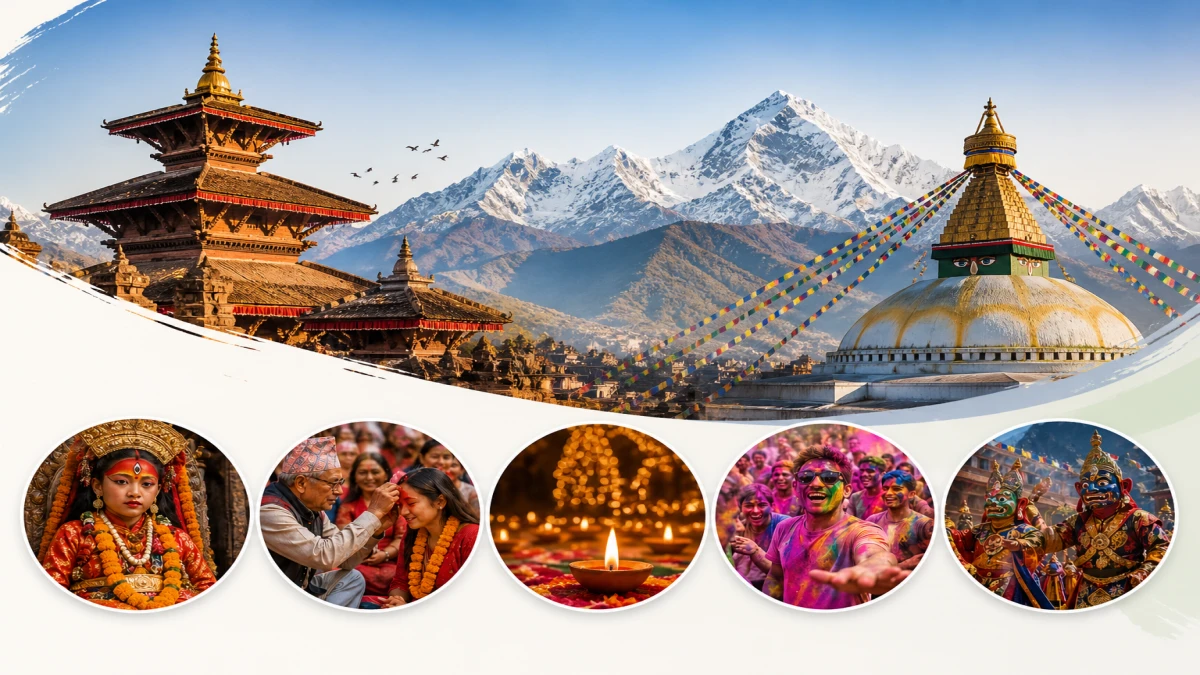
Nepal is not just a destination, it's a living, breathing celebration. Nestled between the towering peaks of the Himalayas and the lush subtropical plains of the Terai, this small but extraordinary country hosts some of the world's most colorful, spiritually profound, and deeply moving festivals throughout the year. If you've ever wondered why travel in Nepal during the festival season is on the bucket list of millions of travelers worldwide, the answer is breathtakingly simple: nowhere else on Earth will you find such an authentic, joyful, and soul-stirring blend of ancient tradition and modern warmth.
From the thunderous drums of Indra Jatra echoing through Kathmandu's medieval streets to the luminous oil lamps of Tihar glowing on every doorstep, Nepal's festivals aren't tourist shows; they're real, raw, and remarkably inclusive. Locals genuinely welcome visitors to share their celebrations, offering blessings, food, and stories that money simply cannot buy. Whether you're a solo adventurer, a culture enthusiast, a family seeking meaningful travel, or a couple looking for a romantic and unforgettable escape, Nepal during its festival season delivers an experience that will stay with you for the rest of your life.
This article dives deep into exactly why Nepal during the festival is the smartest and most rewarding travel decision you can make, backed by cultural expertise, traveler insights, and on-the-ground knowledge.
What Makes Nepal's Festival Culture So Remarkably Unique?
Nepal's festival culture is, quite simply, unlike anything else in the world. The country celebrates over 50 major festivals every year, and that number doesn't even account for the dozens of smaller, community-specific celebrations that pop up in villages, valleys, and mountain communities across all 77 districts. The sheer density and diversity of festivals in Nepal is staggering, and that's precisely what makes traveling here during a festival season so powerfully rewarding.
Why Does Nepal Have So Many Festivals?
Nepal's extraordinary festival richness is rooted in its incredible religious diversity. The country is home to Hindus, Buddhists, Kirats, and Newars, each with their own sacred calendar, mythological traditions, and ceremonial practices. Rather than these communities clashing, they've spent centuries weaving their festivals into a harmonious cultural tapestry. It's common to see Hindu families joining Buddhist Losar celebrations, or Buddhist monks participating in the outer processions of Hindu Dashain. This cross-cultural generosity is at the heart of what makes Nepal's festivals so uniquely special.
The Newar community of the Kathmandu Valley, in particular, has preserved festival traditions that date back over a thousand years. Their festivals, Indra Jatra, Bisket Jatra, Gai Jatra follow a lunar calendar and involve weeks of preparation, living goddess processions, ritual chariots, and community feasts. Witnessing a Newar festival in Bhaktapur or Patan feels like stepping directly into a medieval civilization that somehow survived intact into the 21st century.
How Does the Himalayan Setting Amplify the Festival Experience?
The physical landscape of Nepal adds an almost supernatural dimension to its festivals. Imagine watching fireworks explode above ancient temples while the snow-capped summit of Ganesh Himal glows in the background. Or picture butter lamps flickering against the stone walls of a 12th-century monastery while Himalayan winds carry the sound of monks chanting. The combination of dramatic natural scenery and ancient human tradition creates a sensory experience that no photograph, however stunning, can fully capture. You simply have to be there.
Why Is Dashain the Most Essential Festival to Witness in Nepal?
Of all Nepal's festivals, Dashain is the undisputed king, and if you can only travel to Nepal once for a festival, this is the one to choose. Celebrated over 15 days in September or October (corresponding to the bright fortnight of the Nepali month of Ashwin), Dashain is Nepal's longest, most important, and most beloved festival. It celebrates the victory of the goddess Durga over the demon Mahishasura, symbolizing the triumph of good over evil, a theme that resonates universally.
What Happens During the 15 Days of Dashain?
Dashain isn't a single-day event it unfolds across two full weeks, each day carrying its own rituals and significance. The first nine days, known as Navaratri, involve intensive worship of the goddess Durga in her nine manifestations. Temples across the country, especially the famous Kumari Ghar in Kathmandu and the Dakshinkali Temple on the city's outskirts, see massive crowds of devotees offering flowers, incense, and animal sacrifices.
The tenth day, Vijaya Dashami, is the festival's emotional and spiritual climax. This is when family elders apply a sacred tika (a mixture of red vermillion, yogurt, and rice) to the foreheads of younger family members, bestowing blessings for prosperity, health, and long life. Seeing thousands of families gathered across the country, grandparents blessing grandchildren, brothers blessing sisters, is an extraordinarily moving scene that speaks to the deep bonds of Nepali family culture.
By the fifteenth day, known as Kojagrat Purnima (the full moon), the festival wraps up with late-night worship of Lakshmi, the goddess of wealth. Markets, which had been alive with shoppers buying new clothes and gifts throughout the festival, begin to quiet down, and families start the slow return to their daily lives refreshed, blessed, and connected.
Why Do Travelers Love Dashain So Much?
For travelers, Dashain offers a rare window into the most intimate aspects of Nepali family life. Hotels and guesthouses often host special Dashain dinners, and it's not uncommon for local families to invite foreign guests to join their tika ceremonies. The markets of Kathmandu's Ason and Indrachowk neighborhoods are stacked with colorful goods, the air smells of marigolds and incense, and the streets are filled with children flying bamboo kites, a beloved Dashain tradition. It's joyful, chaotic, generous, and deeply human.
How Does Tihar Transform Nepal Into a Dazzling Festival of Lights?
If Dashain is Nepal's greatest festival, Tihar (also called Deepawali or Diwali) is its most visually stunning. Celebrated five days after Dashain ends, Tihar is Nepal's own Festival of Lights a five-day extravaganza that turns the entire country into a shimmering, lamp-lit paradise.
What Are the Five Days of Tihar and What Do They Celebrate?
Each of Tihar's five days honors a different being, and the progression is both poetic and profound:
Day 1 – Kaag Tihar (Crow Day): Crows, considered messengers of the god of death, are offered food to ensure they carry only good news.
Day 2 – Kukur Tihar (Dog Day): Dogs, Nepal's faithful companions, are garlanded with marigolds, given special food, and honored with a tika. Even street dogs receive this treatment. It's heartwarming and utterly unique.
Day 3 – Laxmi Puja (Cow Day & Goddess of Wealth Day): This is the festival's main day. Cows are worshipped in the morning, and in the evening, every home is illuminated with oil lamps, candles, and electric lights to welcome Laxmi into the household. The sight of Kathmandu from a hilltop on this night, thousands of tiny flames twinkling across the valley, is unforgettable.
Day 4 – Goru Tihar & Govardhan Puja: Oxen are honored for their role in agriculture.
Day 5 – Bhai Tika: Sisters apply a special seven-colored tika to their brothers' foreheads and pray for their long life and health, while brothers offer gifts in return. It's Nepal's version of a sibling appreciation day, and it's incredibly touching to witness.
Why Is Tihar a Must-See for International Travelers?
The sheer beauty of Tihar's lighting alone makes it worth the journey. But beyond the visual spectacle, Tihar offers travelers something even more valuable: a direct experience of Nepal's relationship with the natural world. In a country that honors crows, dogs, and cows as sacred beings not symbolically, but literally, with flowers and food and reverence, you begin to understand a profoundly different way of seeing the world. That philosophical shift alone is worth the plane ticket.
What Spiritual Wonders Does Indra Jatra Reveal in Kathmandu?
Indra Jatra is perhaps the most dramatically spectacular festival in the Kathmandu Valley and one of the least understood by outsiders, which makes experiencing it all the more rewarding. Celebrated in August or September, this eight-day festival in the heart of old Kathmandu honors Indra, the king of the gods and the lord of rain, while also celebrating the annual appearance of the Kumari, Nepal's living goddess.
Who Is the Kumari and Why Is She Central to Indra Jatra?
The Kumari is a pre-pubescent girl selected from the Newar community's Shakya clan through an elaborate ritual process. She is believed to be the living incarnation of the goddess Taleju, and she resides in the Kumari Ghar, a stunning wooden palace adjacent to Kathmandu's Durbar Square. During normal times, the Kumari is rarely seen. But during Indra Jatra, she is ceremonially brought out in an enormous wooden chariot and paraded through the old city streets, where thousands of devotees come to receive her blessing.
For travelers, catching even a glimpse of the Kumari during Indra Jatra is considered extraordinarily auspicious. She sits silently in her chariot, her eyes heavily lined with kohl, dressed in red silk, her third eye painted on her forehead, a tiny, solemn, utterly otherworldly figure carried through streets that haven't fundamentally changed in five centuries.
What Else Happens During Indra Jatra?
Beyond the Kumari procession, Indra Jatra features Mahakali and Kumari chariot processions, Devi dances, and the raising of the Yosin, a massive ceremonial pole in Basantapur Square that marks the festival's beginning. Traditional Newari music fills the air, performed on instruments like the dhimay (a large barrel drum) and the nay (bamboo flute). At night, massive masked dances called Mahakali dances are performed by young men representing terrifying goddesses, complete with elaborate costumes and torchlight, a scene of raw, ancient power that sends genuine shivers down the spine.
Why Do Thousands of Travelers Choose Nepal's Holi Festival Over All Others?
Holi in Nepal is pure, unfiltered joy. Known as the Festival of Colors, Holi is celebrated in March (on the full moon of the Nepali month of Falgun), and it's become one of the most popular festival experiences for international travelers visiting Nepal. While Holi is also celebrated in India, Nepal's version has its own distinct character, slightly more relaxed, wonderfully communal, and deeply connected to the country's agricultural traditions.
What Makes Holi in Nepal Different From Holi Elsewhere?
In Nepal, Holi celebrations differ between the Kathmandu Valley (which follows the Newar tradition and celebrates one day before the rest of the country) and the broader national celebrations. The valley version is more ritual-focused, involving the erection of a ceremonial pole in Basantapur and traditional music. The national celebration, however, is all about color buckets of water, bags of colored powder, and absolute strangers becoming temporary best friends through shared rainbow-drenched chaos.
For travelers, Holi in Thamel (Kathmandu's tourist hub) and in Pokhara's Lakeside district is an absolute blast. Rooftop parties, water balloon fights, and impromptu street dances turn the entire city into a carnival. It's safe, fun, and one of the most genuinely joyful travel experiences Nepal has to offer.
How Does Festival Travel in Nepal Deepen Cultural Understanding?
Travel is most meaningful when it challenges you to see the world differently, and Nepal's festivals do exactly that. In a profound way, attending a Nepali festival isn't just entertainment; it's an education in an entirely different philosophical framework for understanding life, community, nature, and the divine.
Why Are Nepal's Festivals More Than Just Spectacles?
Western tourism often treats festivals as performance events that happen for the benefit of an audience. Nepal's festivals are the opposite. They are living religious and social practices that communities have maintained for generations. When you witness Dashain tika being applied, you're watching a genuine act of love between family members. When you see a cow being honored on the second day of Tihar, you're witnessing a real theological belief about the sacredness of all living creatures. When you hear the drums of Indra Jatra, you're listening to music that has been played in exactly the same way for over a thousand years.
This authenticity is humbling, and it has a way of quietly reshaping the traveler's perspective. Many visitors to Nepal during festival season report returning home with a renewed appreciation for community, ritual, and the deeper meaning of celebration.
What Are the Best 7 Festivals to Visit Nepal For in 2025?
Festival | Month | Location | Highlight |
Holi | March | Nationwide | Color powder celebrations |
Buddha Jayanti | May | Lumbini, Swayambhunath | Birth of the Buddha |
Indra Jatra | August/September | Kathmandu | Living Goddess procession |
Dashain | September/October | Nationwide | Tika blessings, kite flying |
Tihar | October/November | Nationwide | Festival of Lights |
Chhath Puja | October/November | Terai region | Sun worship at riverbanks |
Losar | February | Tibetan communities | Tibetan New Year |
Why Is the Food Experience During Nepal's Festivals Absolutely Extraordinary?
Nepal's festival food culture is a hidden treasure that most travel guides barely scratch the surface of. During major festivals, Nepali families prepare special ritual foods that are not available at any other time of year, and being invited to share these dishes is one of the most intimate and memorable experiences a traveler can have.
What Special Foods Are Prepared During Nepal's Festivals?
During Dashain, families prepare sel roti (a crispy, ring-shaped rice bread fried in ghee), khasi ko masu (goat meat curry, considered especially auspicious), and achar (spicy pickle relishes). During Tihar, the focus shifts to sel roti again, plus kwati (a hearty nine-bean soup that's deeply nourishing) and elaborate sweets made from sesame seeds and molasses. During Holi, thandai (a spiced milk drink sometimes infused with bhang, or cannabis, in a traditional context) and festive snacks are shared among revelers.
Many restaurants in Kathmandu and Pokhara create special festival menus during these periods, and food tours focused specifically on festival cuisine have become increasingly popular. Tasting these dishes connects you directly to the cultural meaning of the celebrations because in Nepal, food is never just sustenance; it's always also an offering, a blessing, and a form of love.
How Does Nepal's Festival Season Enhance Your Trekking and Adventure Plans?
Here's something many adventure travelers don't realize: trekking in Nepal during festival season is not just possible, it's often the best possible combination of adventure and cultural immersion you can find anywhere in the Himalayas.
Why Is Post-Dashain the Best Time to Trek in Nepal?
The weeks immediately following Dashain (October–November) coincide with Nepal's finest trekking weather. The monsoon has departed, leaving the air crystal clear, the mountains sharp and vivid against deep blue skies, and the trails firm and well-maintained. This means that if you time your Nepal trip to include the Dashain or Tihar celebrations in Kathmandu before heading out on the trail, you get the absolute best of both worlds: festival magic in the city followed by world-class Himalayan trekking on trails like the Annapurna Circuit, the Everest Base Camp trek, or the Langtang Valley route.
Along the trail, you'll also encounter smaller village-level festival celebrations that no guidebook can predict, spontaneous moments of music, dancing, and shared food that emerge organically from communities celebrating together. These unscripted encounters are often the most treasured memories trekkers bring home.
What Should Every Smart Traveler Know Before Visiting Nepal During a Festival?
Traveling during Nepal's festival season is overwhelmingly positive, but a little preparation goes a long way toward making your experience seamless and respectful.
How Far in Advance Should You Book Your Nepal Festival Trip?
Book at least 3–6 months in advance for major festivals like Dashain and Tihar. Hotels in Kathmandu and Pokhara fill up quickly during these periods, and flights, particularly into Tribhuvan International Airport, get congested. Internal flights to destinations like Pokhara, Lukla (for Everest treks), or Bharatpur can be especially difficult to book last-minute during festival season. Early planning is essential.
What Are the Practical Challenges of Traveling During Nepal's Festivals?
- Bank and government closures: Many offices, banks, and even some shops close for extended periods during Dashain. Carry sufficient cash.
- Transport disruptions: Buses and shared taxis may be reduced as drivers return to their home villages. Arrange private transport in advance if you have strict schedules.
- Crowds at temples: Major temples like Pashupatinath, Swayambhunath, and Dakshinkali can be extraordinarily crowded during festivals. Arrive early in the morning for the best experience.
- Noise levels: Festivals in Nepal are loud and celebratory. Light sleepers should bring earplugs and choose accommodations accordingly.
For more detailed practical planning, visit All Nepal Hiking for up-to-date logistics information.
Why Are Nepal's Festivals Perfect for Families, Solo Travelers, and Couples?
Nepal's festival season genuinely caters to every type of traveler, and that's one of its greatest strengths.
For families: Children are absolutely central to Nepal's festival culture. The kite-flying of Dashain, the animal-blessing rituals of Tihar, and the color play of Holi are irresistibly engaging for young travelers. Nepali communities are wonderfully welcoming of foreign children, and the festivals offer a living, interactive cultural education that no classroom can replicate.
For solo travelers: Nepal's festivals naturally create community. You'll find yourself surrounded by friendly locals and fellow travelers, sharing food and conversation in ways that don't happen in ordinary travel contexts. The social openness of festival season makes solo travel here feel safe, stimulating, and deeply connected.
For couples: The beauty of festival-lit Nepal, butter lamps glowing on every surface, marigold garlands hanging from doorways, mountains turning gold at sunset, is undeniably romantic. Festival season combines aesthetic beauty with emotional depth in a way that creates powerfully shared memories.
How Can You Respectfully Participate in Nepal's Sacred Festival Traditions?
Participation is welcomed, but thoughtful participation is always appreciated more.
What Are the Key Rules of Festival Etiquette in Nepal?
- Always ask before photographing religious rituals or people engaged in worship. A smile and a nod of inquiry go a long way.
- Dress modestly when visiting temples or joining religious ceremonies. Shoulders and knees should be covered.
- Remove your shoes before entering temples or homes where religious rituals are taking place.
- Accept offerings with your right hand and never point your feet toward a shrine or religious image.
- Don't touch sacred objects unless specifically invited to do so.
When in doubt, follow the lead of local participants. Nepali people are generally gracious and will gently guide well-meaning visitors in the right direction.
What Hidden Festival Gems in Nepal Are Still Off the Tourist Trail?
Beyond the big-name festivals, Nepal hides some extraordinary, smaller celebrations that most travelers never discover.
Which 5 Underrated Nepal Festivals Deserve More Attention?
- Bisket Jatra (Bhaktapur, April): The Nepali New Year festival in Bhaktapur involves the tug-of-war pulling of a massive chariot through narrow medieval streets raw, chaotic, and electrifying.
- Mani Rimdu (Tengboche Monastery, November): A stunning three-day Buddhist festival in the Everest region featuring elaborate masked dances performed by monks.
- Gai Jatra (Kathmandu, August): A Newar festival honoring those who died in the past year, featuring processions of cows (or boys dressed as cows), satirical performances, and a surprisingly joyful celebration of grief.
- Chhath Puja (Terai region, October/November): A mesmerizing sun-worship ritual performed at riverbanks, where devotees stand in water at sunrise and sunset offering prayers. Strikingly beautiful and deeply moving.
- Loshar (February, Tibetan communities in Mustang, Dolpo, and Humla): The Tibetan New Year, celebrated with colorful monastery ceremonies, traditional dance, and community feasts in Nepal's most remote Himalayan districts.
Frequently Asked Questions About Traveling in Nepal During the Festival
Q1: When is the best time to travel in Nepal during the festival?
The best festival months in Nepal are September through November, when Dashain and Tihar take place alongside perfect trekking weather. March is also excellent for Holi. The exact dates shift annually according to the lunar calendar, so check specific dates for your target year before booking.
Q2: Is it safe to travel in Nepal during major festivals?
Yes, Nepal during the festival season is generally very safe for tourists. Petty crime increases slightly in crowded areas (as it does anywhere with large crowds), so standard precautions apply: keep valuables secure and stay aware of your surroundings. The overall atmosphere is celebratory and welcoming.
Q3: Will shops and restaurants be open during Nepal's festivals?
Tourist-oriented restaurants and shops in Thamel and Lakeside (Pokhara) remain open during festivals. However, many locally-run businesses, banks, and government offices close for extended periods during Dashain. Stock up on cash before the festival begins.
Q4: Do I need a special visa to visit Nepal during the festival season?
No special festival visa is required. Standard Nepal tourist visas are available on arrival at Tribhuvan International Airport and at major land border crossings. However, book your accommodation and internal transport well in advance, as demand is extremely high during peak festival periods.
Q5: Can non-Hindus and non-Buddhists participate in Nepal's festivals?
Absolutely. Nepal's festivals are broadly inclusive, and locals genuinely welcome respectful foreign participation. Non-Hindus can attend Dashain celebrations and receive tika blessings; non-Buddhists can attend Losar and Mani Rimdu events. The key is approaching everything with genuine respect and curiosity.
Q6: What should I pack for traveling in Nepal during the festival season?
Pack modest clothing suitable for temple visits (loose trousers, shirts that cover shoulders), comfortable walking shoes for navigating crowded streets, a rain layer (October can still see occasional showers), and old clothes you don't mind getting permanently stained if you plan to participate in Holi. A small day pack, a reusable water bottle, and a good camera round out your festival-travel kit.
Conclusion
Traveling in Nepal during the festival season isn't simply a tourism choice; it's a life-enriching decision. The country's festivals offer something increasingly rare in our fast-paced, digitized world: genuine human community, ancient wisdom expressed through living ritual, extraordinary sensory beauty, and the kind of warmth and welcome that restores your faith in humanity. Whether you're drawn by the spiritual depth of Dashain, the luminous wonder of Tihar, the raw spectacle of Indra Jatra, or the joyful chaos of Holi, Nepal during the festival will give you far more than you arrive expecting.
Plan ahead, travel respectfully, open your heart to the experience, and Nepal during the festival will give you memories that last a lifetime.

.webp)