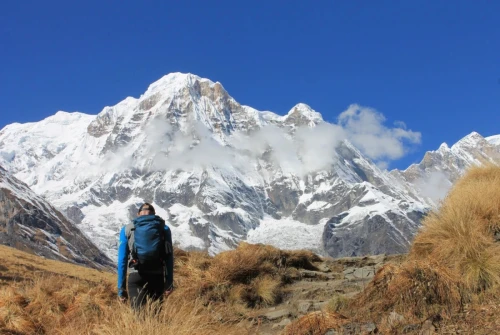
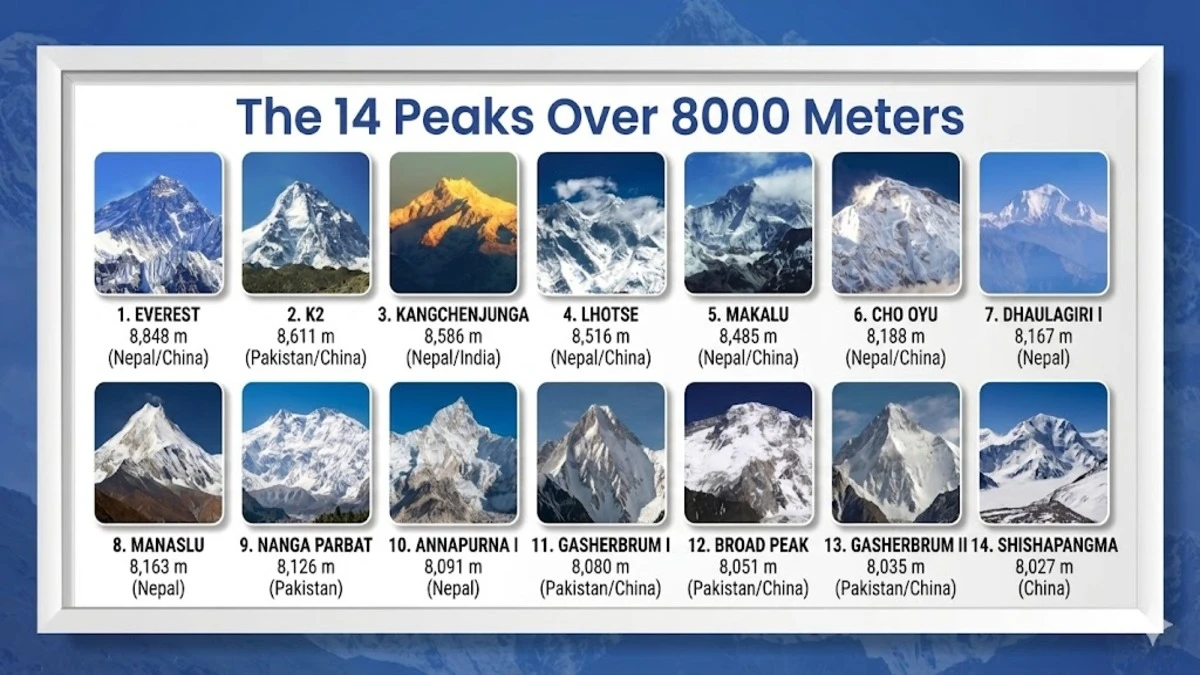
Top 14 Highest Mountains in the World by Height
Rank | Mountain Peak | Height (Meters) | Range | Location |
1 | Mount Everest | 8,848.86m | Himalayas | Nepal / Tibet |
2 | K2 | 8,611m | Karakoram | Pakistan / China |
3 | Kangchenjunga | 8,586m | Himalayas | Nepal / India |
4 | Lhotse | 8,516m | Himalayas | Nepal / Tibet |
5 | Makalu | 8,485m | Himalayas | Nepal / Tibet |
6 | Cho Oyu | 8,188m | Himalayas | Nepal / Tibet |
7 | Dhaulagiri I | 8,167m | Himalayas | Nepal |
8 | Manaslu | 8,163m | Himalayas | Nepal |
9 | Nanga Parbat | 8,125m | Himalayas | Pakistan |
10 | Annapurna I | 8,091m | Himalayas | Nepal |
11 | Gasherbrum I | 8,080m | Karakoram | Pakistan / China |
12 | Broad Peak | 8,051m | Karakoram | Pakistan / China |
13 | Gasherbrum II | 8,034m | Karakoram | Pakistan / China |
14 | Shishapangma | 8,027m | Himalayas | Tibet (China) |
Why the 14 Peaks Define Modern Adventure
All 14 of the world’s highest mountains are located in the infamous Death Zone, where oxygen levels are too low for prolonged human survival without supplemental oxygen. These extreme altitudes test even the most experienced high-altitude climbers, requiring meticulous planning, acclimatization, and expert guidance.
For adventure travelers and mountaineering enthusiasts, regions such as Nepal, Pakistan, and Tibet offer once-in-a-lifetime experiences that combine thrill, culture, and natural beauty:
Everest Base Camp Trek – a classic Himalayan trekking adventure offering panoramic views of Mount Everest, Lhotse, and Ama Dablam, ideal for trekkers seeking the ultimate high-altitude experience.
Everest Three Passes Trek – one of the most challenging Himalayan treks, crossing three high-altitude passes and showcasing stunning glacier landscapes and rugged terrain.
Annapurna Circuit Trek – a diverse route through cultural villages, subtropical forests, and Himalayan vistas, perfect for trekkers looking to combine cultural immersion with mountain adventure.
Scenic Himalayan Flights – breathtaking aerial tours of the world’s tallest peaks, offering a unique perspective for those who want to experience the majestic Himalayas without trekking.
These extraordinary experiences make the Himalayas and Karakoram ranges the ultimate destinations for adventure tourism, high-altitude trekking, and mountaineering expeditions in 2026 and 2027..
Mount Everest (Sagarmatha) : The Roof of the World
Mount Everest is not just the highest point on Earth; it is the ultimate pilgrimage for adventurers. Rising to a staggering 8,848.86 meters, it sits majestically on the border of Nepal and Tibet (China). Whether you are an elite mountaineer or a trekking enthusiast, Everest remains the crown jewel of the Himalayan range.
Mountaineering Facts
Official Height: 8,848.86 meters (29,032 ft)
First Ascent: May 29, 1953, by Tenzing Norgay Sherpa (Nepal) and Sir Edmund Hillary (New Zealand).
Climate & Weather: The summit is home to the jet stream, with temperatures plummeting to -60°C (-76°F) and winds often exceeding hurricane speeds.
Technical Challenges: The treacherous Khumbu Icefall and the legendary Hillary Step (though altered by recent seismic activity) remain iconic tests of skill.
Cultural & Spiritual Heart
For the local communities, Everest is more than a mountain; it is a deity.
In Nepal: Known as Sagarmatha, meaning Goddess of the Sky.
In Tibet: Known as Chomolungma, or Holy Mother.
Sherpa Tradition: Before any expedition, climbers participate in a Puja ceremony to ask the mountain for permission and safe passage.
How to Experience Everest Trekking vs Climbing
While climbing to the summit requires years of training and significant investment, the Khumbu Everest region is accessible to hikers through world-class trekking routes.
Everest Base Camp Trek 14 Days : The most popular choice, allowing for proper altitude acclimatization and visits to the vibrant Sherpa capital, Namche Bazaar.
Everest Short Trek 10 Days: Ideal for travelers with limited time who still want to stand at the foot of the world’s highest peak.
Everest View Trek: A lower-altitude option for those seeking panoramic views without the strain of reaching 5,364m.
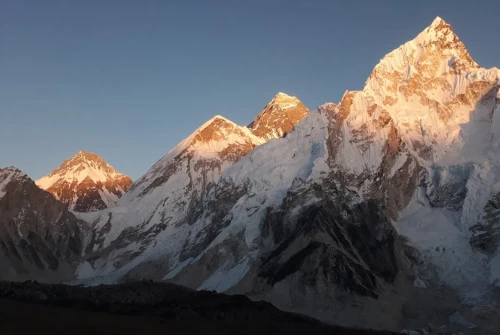
Travel Tip 2026/2027: If you aren't a trekker, the Himalayan Helicopter Tour to Kalapatthar is the fastest way to get a face-to-face view of the summit in a single morning.
Mount K2 : The Savage Mountain (Godwin-Austen)
If Everest is the Roof of the World,K2 is its most formidable guardian. Standing at 8,611 meters, K2 is the second-highest mountain on Earth but is widely considered the most difficult 8,000m peak to climb. Nestled in the heart of the Karakoram Range on the border of Pakistan and China, it remains the ultimate trophy for high-altitude mountaineers.
The Stats of a Giant
Official Height: 8,611 meters (28,251 ft)
First Ascent: July 31, 1954, by Lino Lacedelli and Achille Compagnoni (Italy).
Climate: Notoriously unpredictable. Heavy snowfall and temperatures as low as -50°C (-58°F) create a lethal environment.
Fatality Rate: K2 has earned the nickname The Savage Mountain because for every four people who reach the summit, one dies attempting it.
Why K2 is Different from Everest
Unlike Everest, K2 is a consistent pyramid of rock and ice with almost no flat sections.
The Bottleneck: A treacherous couloir overhung by massive seracs (ice cliffs) that climbers must pass through near the summit.
No Easy Route: There is no walk-up path; every route on K2 requires advanced technical ice and rock climbing skills.
Adventure Beyond the Summit: K2 Base Camp Trek
For those who find the summit too extreme, the K2 Base Camp Trek via Gondogoro La is often cited by seasoned trekkers as the greatest trek in the world.
The Baltoro Glacier: Hikers traverse one of the longest non-polar glaciers on Earth.
Concordia: Known as the Throne Room of the Mountain Gods, this is the only place on Earth where you can see four 8,000m peaks from one spot.
Cultural Experience: The journey takes you through the Baltistan region, where the hospitality of the Balti people provides a warm contrast to the icy landscape.
Mount Kangchenjunga:The Five Treasures of Snow
Rising to 8,586 meters (28,169 ft), Kangchenjunga is the third-highest mountain on Earth. It sits on the remote border between Nepal and Sikkim, India. Unlike the crowded slopes of Everest, Kangchenjunga offers a wilderness experience that feels like stepping back in time.
The Legend of the Five Treasures
The name Kangchenjunga translates to Five Treasures of the High Snow, referring to its five distinct summits. Local Sikkimese and Tibetan people believe these peaks represent five divine repositories:
Gold
Silver
Precious Gems
Grain
Holy Books
Climbing Facts & Modern Ethics
First Ascent: May 25, 1955, by Joe Brown and George Band (UK).
A Sacred Promise: To respect local religious beliefs, the first climbers promised the Chogyal (King of Sikkim) they would stop a few feet short of the actual summit. In 2026, most ethical expeditions still honor this tradition, leaving the very top untouched.
Climate: The region is notorious for heavy monsoonal snowfall and high avalanche risk, making it a technical challenge even for veterans.
Kangchenjunga Trekking: The 2026-2027 Experience
For those seeking an alternative to the busy Everest trails, the Kanchenjunga Circuit Trek is widely considered the best remote trek in Nepal.
Duration: Typically 20 to 22 days.
Highlights: You visit both the North Base Camp (Pangpema) and the South Base Camp (Oktang), offering a 360-degree view of the massif.
Wildlife: The region is a sanctuary for the elusive Snow Leopard and the Red Panda, protected within the Kanchenjunga Conservation Area.
Logistics: More trekkers are opting for the Bhadrapur flight + Jeep route to Taplejung, which is more reliable than the direct Suketar flights.
Mount Lhotse:The Dramatic South Peak
Height: 8,516 meters (27,940 ft)
Location: Nepal–China (Tibet) border
First Ascent: May 18, 1956 – Ernst Reiss & Fritz Luchsinger (Switzerland)
Climate: Extremely cold with strong winds
Cultural Significance: Known as South Peak, often climbed alongside Everest
Standing tall at 8,516 meters, Mount Lhotse is the fourth-highest mountain in the world. Its name, meaning South Peak in Tibetan, perfectly describes its position as Everest’s immediate neighbor, connected via the South Col. While often overshadowed by Everest, Lhotse is a technical powerhouse, offering climbers some of the most challenging ice and rock terrain in the Himalayas.
Climbing Challenges On The Lhotse Face
Lhotse shares much of its route with Everest up to Camp 3, including the treacherous Khumbu Icefall, but it presents unique technical challenges:
The Lhotse Face: A 1,125-meter wall of glacial blue ice with 40–50° pitches, navigable only with expert footwork and fixed ropes.
The Reiss Couloir: The final narrow gully leading to the summit a steep rock and ice corridor demanding precise technical skill.
The South Face: A 3.2 km vertical wall, considered one of the last great climbing problems in the Himalayas and among the most dangerous ascents in the world.
The Modern Trend: The Everest-Lhotse Traverse
Elite climbers are increasingly attempting the Double Header, summiting Everest and Lhotse within 24 hours.
Why it’s popular: Climbers maximize a single weather window and the same permit infrastructure.
Permit Advantage: Lhotse permits are significantly more affordable than Everest permits, making it a high-value peak for mountaineers and peak baggers.
Mount Makalu:The Great Black Pyramid
Height: 8,485 meters (27,838 ft)
Location: Nepal–China (Tibet) border, 19 km southeast of Everest
First Ascent: May 15, 1955 – Lionel Terray & Jean Couzy (France)
Climate: Harsh and unpredictable, with extremely high winds
Difficulty: Technical rock and ice climbing; one of the most challenging 8,000m peaks
Cultural Significance: Less climbed due to remoteness, preserving its pristine environment
Mount Makalu, the world’s fifth-highest peak, is renowned for its distinct four-sided pyramid summit, visible from surrounding Himalayan giants. Often overshadowed by Everest, Lhotse, and Kangchenjunga, Makalu is respected among mountaineers as a technical powerhouse, requiring advanced rock and ice climbing skills. Its steep slopes, exposed faces, and unpredictable weather make it a peak reserved for the most experienced high-altitude climbers.
Makalu-Barun: The Hidden Gem for Trekkers
For non-climbers, the Makalu Base Camp Trek (18–22 days) has grown in popularity, offering a quieter alternative to the busy Everest and Annapurna regions:
The Barun Valley: A living laboratory of Himalayan biodiversity, featuring hanging glaciers, waterfalls, and over 3,000 species of flowering plants.
Solitude & Views: From Shipton La Pass, trekkers can witness rare panoramas of the Big Four: Everest, Lhotse, Makalu, and Kangchenjunga.
Sustainable Travel: Community-based lodges in the Arun Valley support local schools and conservation efforts.
Mount Cho Oyu : The Turquoise Goddess
Standing at 8,188 meters (26,864 ft), Cho Oyu is the sixth-highest mountain in the world. Located on the border between Nepal and Tibet (China), it sits just 20 km west of Mount Everest. Its name translates from Tibetan as the Turquoise Goddess, a nod to the ethereal blue-green glow the peak emits during certain light conditions.
The Easiest Eight-Thousander?
While no 8,000m peak is truly easy, Cho Oyu is statistically the safest and least technical of the group.
The Northwest Face: Most climbers choose this route due to its moderate slopes (typically 30–40 degrees) and lack of extreme technical rock climbing.
High Success Rate: Because of its straightforward terrain, it has the highest success-to-failure ratio among all 14 peaks.
The Technical Crux: The primary challenge is the Yellow Band at approximately 7,700m a short but steep section of mixed rock and ice that requires fixed ropes.
Expedition & Travel Update
First Ascent History: October 19, 1954, by an Austrian team (Herbert Tichy, Joseph Jöchler, and Pasang Dawa Lama). Notably, they summited without supplemental oxygen a feat rarely repeated by first-timers today.
Nangpa La Trade Route: The mountain sits near this glaciated pass, which has served as a vital trade route between Sherpas and Tibetans for centuries.
Experience Cho Oyu: Beyond the Summit
For those not looking to stand on the summit, the region offers world-class trekking and cultural immersion.
Cho Oyu Base Camp Trek: This trek allows you to witness the Turquoise Goddess up close while exploring the high-altitude deserts of the Tibetan Plateau.
Acclimatization Hub: In 2026, many Everest aspirants use a touch-and-go strategy on Cho Oyu to pre-acclimatize, spending several nights above 7,000m to prepare their bodies for the Death Zone.
Gokyo Lakes View: For trekkers on the Nepal side, the Gokyo Ri viewpoint offers perhaps the most stunning panoramic view of Cho Oyu’s massive south face across the Ngozumpa Glacier.
Mount Dhaulagiri I : The Glistening White Mountain
Height: 8,167 meters (26,795 ft)
Location: North-central Nepal
First Ascent: May 13, 1960 – Swiss-Austrian-Nepali expedition
Climate: Extremely unpredictable; prone to avalanches and high winds
Cultural Significance: Named from Sanskrit Dhavala (White) and Giri (Mountain); revered by local Magar and Gurung communities as a guardian of the region
Dhaulagiri I, the seventh-highest mountain on Earth, earned its nickname The White Mountain due to its gleaming snow-covered peaks. For decades in the early 19th century, it was thought to be the tallest mountain on the planet until surveys revealed Kangchenjunga and Everest surpassed it.
Known for its extreme isolation, vertical ice faces, and technical climbing routes, Dhaulagiri remains a peak for elite mountaineers seeking a true high-altitude challenge. Unlike Everest, which is increasingly commercialized, Dhaulagiri demands self-sufficiency, technical ice climbing expertise, and careful planning.
The mountain’s first successful ascent in 1960 was historically notable as the first Himalayan expedition supported by a fixed-wing aircraft, although the aircraft tragically crashed on the mountain.
The White Mountain Challenge
Technical Difficulty: Steep ice slopes, rock towers, and avalanche-prone sections make it one of the most demanding climbs in the Himalayas.
Climber Requirements: High-level technical skill, experience with extreme altitudes, and acclimatization are essential.
Dhaulagiri Base Camp Trek 2026/2027 Off-the-Beaten-Path Adventure
For trekkers not aiming to summit, the Dhaulagiri Base Camp Trek (18–21 days) offers a remote and less crowded Himalayan experience. In 2026-2027, it is emerging as the premier wilderness trek in Nepal:
French Pass & Dhampus Pass: Cross two high-altitude passes over 5,000 meters, offering a challenging trek comparable to Himalayan expeditions.
The Hidden Valley: A pristine high-altitude desert surrounded by snow-capped peaks, largely untouched by modern tourism.
Tukuche Peak Views: Witness dramatic 8,000m drops into the Kali Gandaki Gorge, the deepest gorge in the world.
Adventure & Safety Facts
Climate: Highly unpredictable; avalanches are common after fresh snowfall, especially in autumn.
Location Influence: Dhaulagiri acts as a natural barrier shaping the weather of the Pokhara Valley.
Cultural Connection: The Magar and Gurung people perform seasonal rituals, honoring the mountain as a protector of their lands and harvests.
Mount Manaslu : The Mountain of the Spirit
Height: 8,163 meters (26,781 ft)
Location: Mansiri Himal, west-central Nepal
First Ascent: May 9, 1956 – Toshio Imanishi & Gyalzen Norbu (Japan/Nepal)
Climate: Cold with heavy snowfall; high avalanche risk
Cultural Significance: Known as the Mountain of the Spirit, derived from the Sanskrit word Manasa (intellect or soul), revered by local Gurung and Tibetan communities
Standing as the eighth-highest peak in the world, Manaslu combines high-altitude adventure with spiritual and cultural depth. Nicknamed the Japanese Mountain for its historic first ascent, it remains a less crowded alternative to Everest and Annapurna, offering climbers and trekkers both challenging terrain and serene Himalayan vistas.
In 2026, Manaslu celebrated its Platinum Jubilee 70 Years of First Ascent, marking seven decades of mountaineering history with commemorative events in Nepal and Japan. Statues of the first summiteers were unveiled in Samagaun, and a new 3D model of the mountain is now displayed at the International Mountain Museum in Pokhara, honoring the historic climb and diplomatic bonds between the two countries.
Climbing Highlights True Summit Verification
One of the key 2026 updates for climbers is the focus on reaching the True Summit:
The Fore-Summit Challenge: For years, many climbers stopped at a false shelf just below the summit.
Modern Verification: GPS tracking and drone footage are now standard to ensure climbers reach the final, exposed corniced ridge the actual highest point.
Technical Difficulty: While less steep than K2, the summit ridge is narrow, exposed, and requires precise footwork and extreme caution.
Manaslu Circuit Trek 2026/2027 New Frontier
As trekking in Everest and Annapurna becomes increasingly crowded, the Manaslu Circuit Trek Via Larke La Pass 5106 M has emerged as Nepal’s top unspoiled Trekking route:
Duration: 14–18 days, suitable for seasoned trekkers seeking isolation and high-altitude experience.
Larkya La Pass (5,106 m): The trek’s climax offers 360-degree panoramic views of the Ganesh Himal and Annapurna ranges.
Solo Trekking Update (2026): Solo trekkers can now enter the Manaslu restricted area with a licensed guide no trekking partner required for permits.
Eco-Tourism Upgrade: New teahouse sanitation and waste protocols in villages like Lho and Samagaun ensure the region remains pristine.
Adventure & Safety Facts
Avalanche Risk: Known as the Avalanche Capital of the 8,000m peaks, especially between Camp 1 and Camp 2.
Technical Climbing: Requires experience in high-altitude ice, snow, and rock terrain; the final summit ridge is particularly narrow and exposed.
First Nepali Ascent: Urkien Tshering Sherpa, April 22, 1973, now honored with a statue in Samagaun.
Mount Nanga Parbat : The Killer Mountain
Standing at 8,126 meters (26,660 ft), Nanga Parbat is the ninth-highest mountain in the world. Located in the Gilgit-Baltistan region of Pakistan, it serves as the western anchor of the entire Himalayan range. Its name translates from Sanskrit to Naked Mountain,but it is globally feared and respected as the Killer Mountain (Schicksalsberg in German).
The Wall of Giants: The Rupal Face
Nanga Parbat is home to the Rupal Face, widely considered the highest mountain face in the world.
The Scale: It rises an incredible 4,600 meters (15,000 ft) from the base to the summit in a single, uninterrupted wall of rock and ice.
Technicality: Climbing the Rupal Face is an elite-level feat that requires superior technical skills in mixed rock and ice climbing.
The Diamir Face: While the standard route, the Diamir Face is still fraught with objective dangers, including massive serac falls and avalanches.
Legendary Firsts & 2026 Mountaineering
Hermann Buhl (1953): The first ascent remains one of the greatest feats in human history. Austrian climber Hermann Buhl reached the summit solo and without supplemental oxygen, even surviving a night standing up on a narrow ledge at 8,000m.
Modern Expeditions in 2026: In the current 2026 season, Nanga Parbat continues to be a high-stakes arena. Unlike the traffic jams seen on Everest, a summit on Nanga Parbat in 2026 still carries immense prestige due to the lack of infrastructure and the mountain's raw, uncompromising nature.
Safety Update: Technology in 2026, such as advanced satellite weather modeling and lightweight GPS beacons, has improved safety, yet the mountain’s high fatality-to-summit ratio remains a sobering reality for all teams.
Fairy MeadowsThe World’s Most Beautiful Base Camp
You don’t have to be a Killer Mountain climber to experience the magic of Nanga Parbat.
Fairy Meadows Trek: Often called Heaven on Earth, this trek offers a front-row seat to the Raikot Face. In 2026, it remains one of Pakistan's most sought-after eco-tourism destinations.
The Jeep Track: The journey begins with one of the world's most thrilling (and narrow) jeep rides from the Karakoram Highway to Tato village, followed by a relatively easy 3-hour hike.
2026 Travel Tip: Sustainable tourism initiatives in Gilgit-Baltistan now encourage Plastic-Free trekking in the Fairy Meadows area to protect the pristine alpine meadows.
Adventure & Safety Facts
Climate: The mountain is exposed to sudden storms coming off the plains of Pakistan, leading to rapid whiteout conditions.
Fatality Rate: Historically, it was the deadliest mountain in the world. While modern equipment has helped, it still ranks among the top 3 most dangerous 8,000m peaks.
Best Window: May to June is the primary window for the 2026 spring season, before the monsoon moisture makes the snow slopes too unstable.
Mount Annapurna I :The Goddess of Harvests
Height: 8,091 meters (26,545 ft)
Location: North-central Nepal, Annapurna Massif
First Ascent: June 3, 1950 – Maurice Herzog & Louis Lachenal (France)
Climate: Unpredictable with high avalanche risk
Cultural Significance: Revered as the Goddess of the Harvests, protector of food and fertility in local Gurung and Magar communities
Standing as the 10th highest peak in the world, Annapurna I is both awe-inspiring and deadly. Its Sanskrit name Anna (food) and Purna (filled) translates to Provider of Nourishment, reflecting its spiritual significance. Despite the gentle connotation, Annapurna I is notorious for being one of the most dangerous 8,000-meter mountains, with a historical fatality rate of nearly 32%, primarily due to avalanches.
A Legacy of Firsts: 1950 Milestone
Historic Achievement: French climbers Maurice Herzog and Louis Lachenal reached the summit, marking the first successful ascent of any 8,000m peak, three years before Everest.
Survival Story: Both climbers suffered severe frostbite, losing fingers and toes, a testament to the mountain’s extreme conditions.
Impact: Annapurna I set the stage for modern high-altitude mountaineering and remains a benchmark of Himalayan adventure.
2026-2027 Safety & Climbing Realities
The Death Zone: Despite modern gear and satellite-assisted forecasting, Annapurna I remains perilous.
Objective Dangers: Avalanches dominate the risk profile, especially along the North Face Sickle Route and steep ice walls.
The Annapurna Sanctuary Trekking Paradise in 2026-2027
While the summit is reserved for elite climbers, the Annapurna Conservation Area (ACAP) offers world-class trekking:
Annapurna Base Camp Trek: Leads through a natural amphitheater of 7,000–8,000m peaks. In 2026-2027, eco-conscious Green Lodges powered by solar energy and zero-waste systems dominate the route.
Annapurna Circuit: Classic multi-day trek remains popular. The 2026-2027 Off-Road Trail initiative allows trekkers to bypass newly built motor roads, staying on traditional footpaths.
Cultural Highlights: Witness Gurung and Magar traditions like the Ghatu and Maruni dances, performed to honor the mountain during harvest festivals.
Adventure & Safety Facts
Climate: Receives some of the Himalayas’ highest precipitation, creating heavy snow and unstable slopes.
Technical Difficulty: Extreme; avalanche-prone and requires experience in high-altitude trekking and mountaineering.
2026/2027 Best Time to Visit: Mid-April to May (Spring) and October to November (Autumn) for stable conditions around high-altitude passes like Thorong La Pass (5,416m).
Gasherbrum I : The Hidden Peak
Height: 8,080 meters (26,509 ft)
Location: Pakistan–China (Karakoram Range)
First Ascent: July 5, 1958 – Pete Schoening & Andy Kauffman (USA)
Climate: Harsh and unpredictable; exposed to extreme winds and sudden storms
Cultural Significance: Known as the Hidden Peak for its remote location and unobtrusive presence among the giants of the Karakoram
Gasherbrum I is the eleventh-highest mountain in the world and remains one of the most remote and spectacular 8,000m peaks. Its isolation in the Karakoram makes it less frequented than Everest or K2, providing a true adventure experience for elite mountaineers. Despite being slightly lower than nearby Gasherbrum II, it demands exceptional technical skill due to steep ice walls, mixed climbing routes, and extreme weather conditions.
Climbing Highlights 2026-2027 Season
Technical Challenge: The summit push involves climbing steep ice faces and rock ridges. Crevasse-laden glaciers require precise route-finding skills.
Weather Factors: High winds and sudden storms make Gasherbrum I a peak where climbers must be ready to adjust plans on the fly.
2026-2027 Trend: More climbers are attempting the Karakoram Double summiting Gasherbrum II first, then Gasherbrum I within a single expedition window.
Trekking & Base Camp Adventure
For non-summit seekers, the Gasherbrum Base Camp Trek (18–20 days) offers:
Stunning Karakoram Landscapes: Glacial valleys, towering ice cliffs, and panoramic views of the surrounding peaks including K2 and Broad Peak.
Remote Wilderness Experience: Far from the crowds of Everest and Annapurna, the trek is ideal for those seeking solitude.
Local Culture & Sustainability: Trekking routes pass through small Balti villages where community-based lodges allow visitors to support local education and conservation projects.
Adventure & Safety Facts
Climate: Extremely cold, with high winds and heavy snowfall; sudden storms can last for days.
Difficulty: Advanced; technical climbing experience required for summit attempts.
Best 2026-2027 Season: June to August offers the most stable weather window for both trekking and climbing expeditions.
Broad Peak : The Extensive Ridge
Height: 8,051 meters (26,414 ft)
Location: Pakistan–China (Karakoram Range)
First Ascent: June 9, 1957 – Austrian team
Climate: Frequent snowstorms, high winds, and sudden weather shifts
Cultural Significance: Named for its exceptionally wide summit ridge, offering a unique climbing profile among the 8,000m peaks
Broad Peak is the 12th highest mountain in the world, famous for its remarkably long, continuous summit ridge stretching over 1.5 kilometers. Located in the Karakoram Range, it sits just northeast of K2 and Gasherbrum I, making it part of a formidable cluster of the world’s highest and most challenging peaks. While technically slightly easier than K2, Broad Peak demands stamina, precision, and high-altitude climbing expertise.
Climbing Highlights: 2026 Season
The Broad Ridge Challenge: The mountain’s defining feature is its extended ridge, which requires careful pacing and acclimatization. The summit ridge often faces severe winds, creating exposure hazards.
Weather Conditions: Climbers in 2026 must prepare for sudden blizzards and rapidly changing conditions, especially above Camp 3.
Karakoram Combo Trend: Increasingly, mountaineers are pairing Broad Peak with Gasherbrum I or K2 in a single expedition, leveraging shared logistics and acclimatization.
Trekking & Base Camp Adventure
Base Camp Experience: Broad Peak Base Camp is a less-crowded alternative to K2 Base Camp, offering panoramic views of the Karakoram giants.
Scenic Highlights: Trekkers can witness glacial streams, icefalls, and the surrounding high peaks of the Baltoro Glacier region.
Local Culture & Sustainability: Small Balti villages along the route provide community-run lodges, promoting eco-friendly trekking and supporting local schools and conservation efforts.
Adventure & Safety Facts
Gasherbrum II : The Radiant Mountain
Height: 8,035 meters (26,362 ft)
Location: Pakistan–China border (Karakoram Range, Gilgit-Baltistan / Xinjiang)
First Ascent: July 7, 1956 – Fritz Moravec, Josef Larch & Hans Willenpart (Austria)
Climate: Harsh and unpredictable; prone to high-velocity winds and icy ridges
Cultural Significance: Known as the Radiant Mountain (Balti: rgasha brum – beautiful mountain), it is the most approachable of the Karakoram giants
Standing as the thirteenth-highest peak on Earth, Gasherbrum II (G2) is a part of the formidable Gasherbrum massif yet is celebrated as the most accessible 8,000-meter Karakoram peak. Its classic Southwest Ridge route is relatively free of extreme rock climbing or major icefall hazards, making it a popular choice for climbers transitioning from 7,000m peaks to the Death Zone.
Unlike its towering neighbor Gasherbrum I, G2 combines technical challenge with approachability, offering steep final slopes while maintaining manageable glacier access, making it ideal for high-altitude training and adventure seekers.
Climbing Highlights: 2026 Updates
The Perfect First 8,000er: The Southwest Ridge remains the most popular and safe route for climbers seeking their first summit above 8,000 meters.
Safety Technology: GPR (Ground Penetrating Radar) is now widely used to map hidden crevasses, reducing risk on the glacier approach.
Gasherbrum Double: Climbers increasingly combine G1 and G2 in a single expedition, sharing base camp and optimizing acclimatization for both peaks.
Trekking & Base Camp Experience
Shared Base Camp: Gasherbrum II Base Camp serves climbers attempting both G1 and G2. In 2026, it hosts an international mix of elite mountaineers.
Spectacular Vistas: From G2, trekkers enjoy unparalleled views of Gasherbrum I (Hidden Peak), Broad Peak, and the Trango Towers.
Eco-Tourism & Local Culture: The Balti people lead Clean-up Treks,encouraging low-impact adventure while providing discounts for volunteers removing old gear and waste from higher camps.
Adventure & Safety Facts
Technical Difficulty: Moderate for 8,000-meter peaks; final pyramid is steep, requiring precise crampon work.
Climate Risks: High-velocity winds can expose bare ice; crevasse hazards are significant between Base Camp and Camp 1.
Best Climbing Window: Late June to early August.
Height: 8,035 meters (26,362 ft)
Location: Border of Gilgit-Baltistan (Pakistan) and Xinjiang (China)
Shishapangma: Tibet’s Hidden Gem
Height: 8,027 meters (26,335 ft)
Location: Tibet, China
First Ascent: May 2, 1964 – Xu Jing (China)
Climate: Cold, prone to strong winds and sudden snowstorms
Cultural Significance: Known as Gosainthan in Nepal, Shishapangma is the only 8,000-meter peak entirely within Tibet
Standing as the fourteenth-highest mountain on Earth, Shishapangma is often called Tibet’s Hidden Gem. Its unique distinction of being entirely within Tibetan territory makes it less trafficked than Everest, K2, or other Himalayan giants. The peak offers remote, serene, and high-altitude challenges that attract climbers seeking both adventure and solitude.
Shishapangma’s approach rewards trekkers and mountaineers with panoramic views of the surrounding Himalayas and glaciers, giving a sense of isolation and untouched natural beauty. Its northwest and central ridges are the most commonly attempted routes, featuring manageable technical sections compared to other 8,000m peaks but still requiring careful acclimatization and preparation.
Expedition Highlights
Remote Access: The standard Base Camp trek passes through quiet Tibetan valleys, far from the commercialized trails of Nepal.
Climbing Strategy: In 2026-2027, elite teams focus on minimizing time in the Death Zone using precise weather window predictions, supplemented with GPS and high-altitude drones for route reconnaissance.
Training Ground: Shishapangma is an ideal peak for climbers attempting their first Tibetan 8,000er, offering technical yet relatively straightforward climbing compared to K2 or Annapurna.
Conservation & Local Engagement: Guided by local Tibetan Sherpas, expeditions increasingly emphasize low-impact trekking, preserving sacred areas and natural ecosystems around Base Camp.
Adventure & Safety Facts
Technical Difficulty: Moderate for an 8,000-meter mountain; mainly snow and ice climbs with crevasse hazards.
Climate Risks: Sudden snowstorms, strong winds, and extreme cold.
Best Climbing Window: Late April to early June, and September to October
Height: 8,027 meters (26,335 ft)
Location: Central Tibet, north of the Nepal border
Conclusion
Asia’s highest mountains represent both the pinnacle of natural beauty and the ultimate test of human endurance. From the iconic Mount Everest to the remote Shishapangma, these peaks have fascinated climbers, trekkers, and adventurers for decades. Whether you are planning a trekking expedition, a mountain climbing adventure, or simply want to marvel at the majestic Himalayas and Karakoram ranges, these 14 mountains offer inspiration, challenge, and unforgettable experiences.
 based on 270 reviews



.webp)