based on 270 reviews

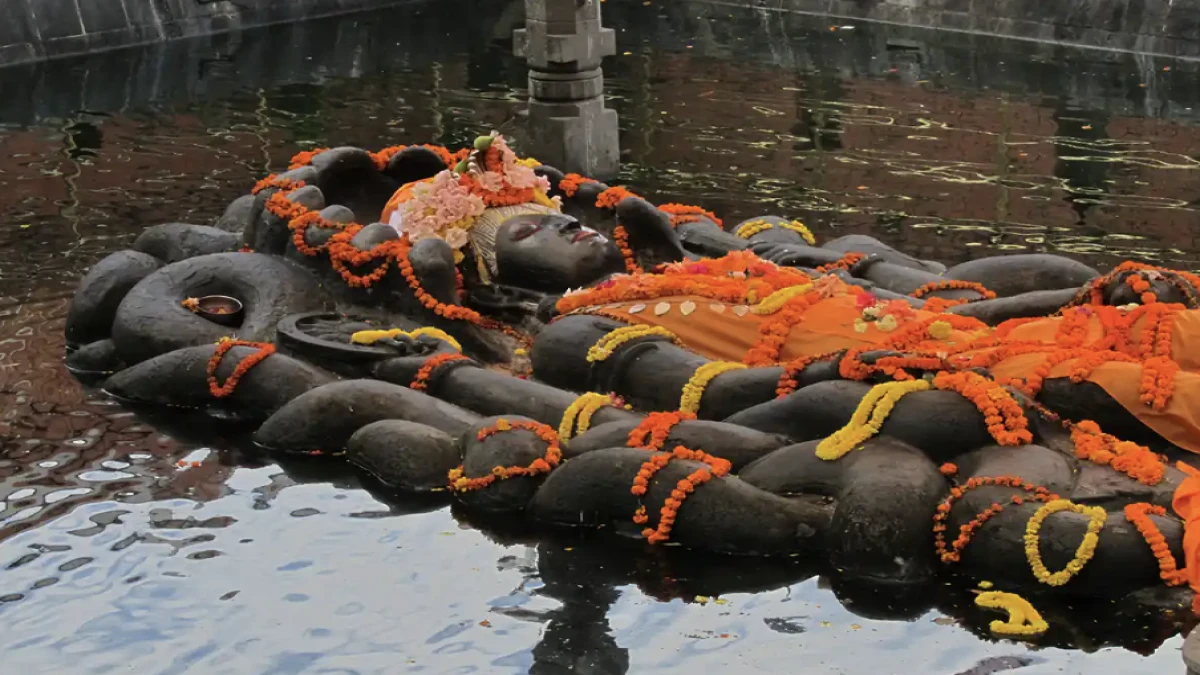
In the northern part of the Kathmandu Valley, beneath the green foothills of Shivapuri, lies one of Nepal's most remarkable sacred monuments: the Sleeping Vishnu of Budhanilkantha. Known locally as Jalashayan Narayan, this extraordinary stone image portrays Lord Vishnu reclining peacefully upon the cosmic serpent Shesha in the middle of a sacred pond.
For religious travelers, Budhanilkantha is much more than an impressive ancient sculpture. It is a living place of worship where mythology, Hindu philosophy, ancient Nepali art and centuries-old traditions continue to meet. The Nepal Tourism Board identifies the monument as one of Nepal's major pilgrimage attractions and describes the approximately five-meter-long granite image as one of the country's largest stone statues of Vishnu.
The peaceful expression of the deity, the enormous serpent beneath him, and the surrounding water create a fascinating spiritual setting. Every detail carries symbolic meaning, while local legends add another layer of mystery to this already extraordinary religious site.
Where Is the Sleeping Vishnu Temple?
Budhanilkantha Temple is located in Budhanilkantha, at the northern end of the Kathmandu Valley, near the foothills of the Shivapuri hills. It is approximately 8–9 kilometers north of central Kathmandu, making it relatively easy to visit as part of a Kathmandu sightseeing or religious tour.
The temple's location makes it particularly appealing to visitors who want to experience both religious heritage and the natural landscape of the Kathmandu Valley. The surrounding hills provide a peaceful contrast to the busy urban areas of Kathmandu.
Visitors can reach Budhanilkantha by private vehicle, taxi, or public transportation from Kathmandu. The Nepal Tourism Board notes that regular microbuses connect the area with the city center.
Who Is the Sleeping Vishnu?
The Sleeping Vishnu represents Lord Vishnu, one of the principal deities of Hinduism and one of the members of the Hindu Trimurti, alongside Brahma and Shiva.
Vishnu is traditionally associated with preservation, protection, and the maintenance of cosmic order. Rather than depicting Vishnu standing or seated, the Budhanilkantha sculpture shows him reclining in a state of divine rest.
This posture is commonly associated with Yoga Nidra, or yogic sleep. In Hindu cosmology, Vishnu's cosmic sleep is not ordinary human sleep. It represents a profound state connected with the cycles of existence and the preservation of the universe.
The image is therefore not simply a representation of a sleeping god. The Sleeping Vishnu symbolizes cosmic balance, eternity and the continuing cycle of creation and preservation.
The Magnificent Sleeping Vishnu Statue
The central attraction of Budhanilkantha is the enormous reclining image of Vishnu.
The sculpture is approximately five meters long and was carved from a single large stone. The Nepal Tourism Board associates the sculpture with the Licchhavi period, one of the most important periods in the development of Nepalese art and architecture.
The figure lies horizontally inside a water-filled stone tank, creating the remarkable impression that Vishnu is resting upon the surface of a cosmic ocean.
The craftsmanship is especially impressive when viewed closely. The sculptor created the deity's facial features, ornaments, limbs, and symbolic objects with remarkable precision despite working with a massive block of stone.
The Sleeping Vishnu is widely regarded as an outstanding example of ancient Nepali stone sculpture and is considered one of the most important surviving works associated with the Licchavi artistic tradition.
Why Is Vishnu Sleeping on a Serpent?
One of the most recognizable features of the Budhanilkantha statue is the enormous serpent beneath Vishnu.
This serpent is known as Shesha or Ananta, the cosmic serpent associated with eternity and infinity. Vishnu is traditionally depicted reclining upon the coils of Shesha while the serpent's multiple heads rise behind him like a protective canopy.
The imagery is deeply symbolic.
The water represents the cosmic ocean, while Shesha represents the endless nature of existence. Vishnu's reclining form represents divine preservation and cosmic rest.
Together, these elements create a visual representation of Hindu cosmology. What appears to be a simple scene of a deity resting on a serpent is actually a carefully constructed religious image containing layers of philosophical meaning.
The Four Symbols of Lord Vishnu
A closer look at the Sleeping Vishnu reveals several traditional attributes associated with the deity.
Vishnu is traditionally represented with four principal objects:
Sudarshana Chakra – the divine discus
Shankha – the conch shell
Gada – the mace
Padma – the lotus
These objects are important symbols within Vaishnavism and help identify the deity represented by the sculpture.
The four-armed form of Vishnu is one of the most recognizable representations of the god throughout Hindu religious art. At Budhanilkantha, these attributes form part of the larger symbolic composition surrounding the reclining deity.
History of the Sleeping Vishnu at Budhanilkantha
The exact history of the statue remains a subject of interest among historians, archaeologists, and religious scholars.
The Nepal Tourism Board places the sculpture within the Licchavi period, while various sources associate its creation with the early medieval history of the Kathmandu Valley. A Nepalese academic study identifies the Sleeping Vishnu as one of the most significant stone sculptures of the Licchavi era.
The Licchavi period was particularly important for the development of Hindu and Buddhist art in Nepal. Stone sculpture, metalwork, architecture, and religious traditions flourished during this era.
The Sleeping Vishnu therefore has importance beyond its religious role. It is also an important example of Nepal's ancient artistic heritage.
The Legend of How the Statue Was Discovered
One of the most popular stories surrounding Budhanilkantha tells of a farmer who was working in a field.
According to local folklore, the farmer's plough struck a large stone. When the area was investigated, the discovery was believed to reveal the magnificent image of Vishnu hidden beneath the ground. The Nepal Tourism Board records this traditional story as part of the history associated with the site.
The story has become an important part of the identity of Budhanilkantha.
Whether approached as a religious tradition or as folklore surrounding an ancient archaeological monument, the story contributes to the mystery of how such a monumental sculpture came to be situated at the site.
Why Is Budhanilkantha Called the Sleeping Vishnu?
The name Sleeping Vishnu comes directly from the posture of the main deity.
Rather than sitting on a throne or standing upright, Vishnu is shown reclining horizontally upon Shesha. This form is known as Jalashayan Narayan, referring to Vishnu reclining in or upon water.
The pond surrounding the statue is especially important because it reinforces the image of Vishnu resting upon the cosmic ocean.
For Hindu pilgrims, seeing the deity in this form is an opportunity to experience a particular representation of Vishnu that is relatively uncommon and exceptionally large.
Religious Significance of Budhanilkantha
Budhanilkantha remains an active pilgrimage destination rather than simply an archaeological attraction.
Hindu devotees visit the temple to pray, make offerings, and receive darshan of Lord Vishnu. The temple becomes particularly significant during major Vaishnavite festivals and Ekadashi observances.
The Nepal Tourism Board specifically highlights Harishayani Ekadashi and Haribodhini Ekadashi as important occasions at Budhanilkantha. These festivals are associated with the traditional four-month period during which Vishnu is believed to enter his cosmic sleep.
During these occasions, large numbers of devotees gather at the temple, transforming the area into an important religious celebration.
Haribodhini Ekadashi and the Awakening of Vishnu
One of the most important occasions at Budhanilkantha is Haribodhini Ekadashi, which marks the traditional awakening of Vishnu after his four-month period of cosmic sleep.
The festival normally falls around October or November, according to the Hindu lunar calendar. It attracts large crowds of pilgrims who come to worship the deity and participate in religious rituals.
For religious tourists, visiting Budhanilkantha during Haribodhini Ekadashi provides a very different experience from visiting on an ordinary day.
The atmosphere becomes highly devotional, with pilgrims, religious ceremonies and traditional practices surrounding the temple.
Budhanilkantha and Hindu-Buddhist Religious Harmony
Although Budhanilkantha is principally a shrine dedicated to Vishnu, the site also has significance within Nepal's broader tradition of Hindu-Buddhist religious coexistence.
Research on Nepali sculpture has noted the visual and religious associations between the Sleeping Vishnu and Buddhist traditions, including interpretations connected with Avalokiteshvara or Lokeshvara.
This is particularly significant in the Kathmandu Valley, where Hindu and Buddhist traditions have interacted for centuries.
The site consequently provides religious travelers with an opportunity to observe one of the defining characteristics of Nepal's spiritual heritage: different religious traditions existing alongside one another and sharing cultural spaces and artistic influences.
The Royal Legend of Budhanilkantha
Budhanilkantha is also surrounded by a fascinating story concerning Nepal's former monarchy.
According to a long-standing legend, King Pratap Malla had a prophetic dream associated with the Sleeping Vishnu. The tradition held that Nepal's reigning monarch should not visit the original image because doing so would bring death or misfortune.
The story became deeply associated with the history of the Nepalese monarchy and contributed to the unusual status of Budhanilkantha.
Historical and cultural accounts also describe smaller representations of the Sleeping Vishnu at other locations, including Balaju and the Hanuman Dhoka area. (ECS NEPAL)
The royal legend should be understood as a traditional belief rather than established historical fact, but it remains an intriguing part of Budhanilkantha's cultural history.
What Makes the Sleeping Vishnu Unique?
Several features distinguish Budhanilkantha from other religious sites in Kathmandu:
The enormous reclining form of Lord Vishnu
The sculpture carved from a single stone
The cosmic serpent Shesha beneath Vishnu
The sacred pond surrounding the deity
Its connection with the ancient Licchavi artistic tradition
Its importance during Harishayani and Haribodhini Ekadashi
Its association with Hindu-Buddhist cultural traditions
The legends surrounding its discovery and Nepal's monarchy
Its location beneath the Shivapuri hills
Its continuing role as an active pilgrimage destination
These characteristics make Budhanilkantha both a religious destination and an important cultural heritage site.
Best Time to Visit Sleeping Vishnu
Visitors can visit Budhanilkantha throughout the year, but the experience differs depending on the season.
For travelers interested primarily in the religious atmosphere, Haribodhini Ekadashi is one of the most significant times to visit. Large numbers of devotees gather to celebrate the awakening of Vishnu, and the temple becomes especially lively.
However, travelers who prefer a quieter experience may wish to visit outside major festival periods.
A visit during a less crowded period allows more time to observe the sculpture, understand its symbolism, and appreciate the surrounding environment without the intensity of a major religious gathering.
How to Visit Budhanilkantha Temple
Budhanilkantha can easily be incorporated into a Kathmandu religious sightseeing itinerary.
From central Kathmandu, travelers can travel north toward Budhanilkantha by taxi, private vehicle or public transportation. The Nepal Tourism Board lists the site as approximately 9 kilometers from Kathmandu's city center and notes the availability of regular microbus services.
A visit to Budhanilkantha can also be combined with other attractions in northern Kathmandu and the surrounding hills, making it suitable for a half-day cultural excursion.
Things to Know Before Visiting Sleeping Vishnu
Budhanilkantha is an active religious shrine, so visitors should approach the site respectfully.
We recommend keeping the following points in mind:
Dress modestly, particularly when visiting as part of a religious tour.
Maintain a respectful attitude around worshippers and religious ceremonies.
Follow instructions from temple authorities regarding photography and access.
Do not disturb devotees while they are praying or performing rituals.
Avoid treating the temple purely as a photo opportunity.
Observe local customs regarding access to sacred areas.
During major festivals, expect large crowds and allow additional travel time.
The exact access rules for visitors may vary according to religious activities and temple management, so it is best to follow the instructions provided at the site.
Sleeping Vishnu as a Religious Tourism Destination in Nepal
For religious tourists traveling through Nepal, Budhanilkantha offers an opportunity to experience a different side of Kathmandu's spiritual heritage.
While destinations such as Pashupatinath are renowned for Shiva worship and Swayambhunath and Boudhanath are strongly associated with Buddhist traditions, Budhanilkantha provides an extraordinary window into Nepal's Vaishnavite heritage.
The combination of ancient sculpture, mythology, living worship and natural surroundings makes the site particularly valuable for travelers interested in religious history.
It also demonstrates why the Kathmandu Valley is recognized as a place where religion, art, architecture and everyday cultural life remain closely connected.
Why You Should Visit the Sleeping Vishnu in Kathmandu
The Sleeping Vishnu is not merely an ancient statue placed inside a temple. It is a living religious monument that continues to hold deep significance for devotees.
Standing beside the sacred pond and looking at the five-meter-long figure reclining upon Shesha provides a remarkable encounter with Nepal's ancient artistic heritage. The sculpture's scale is impressive, but its symbolism is even more powerful.
Here, water becomes the cosmic ocean, Shesha becomes eternity, and Vishnu's sleep becomes a representation of the cosmic cycle.
For religious travelers, Budhanilkantha offers an opportunity to connect with an important Vaishnavite pilgrimage tradition. For history enthusiasts, it provides a remarkable example of ancient Nepali sculpture. For cultural travelers, it reveals the continuing relationship between Nepal's Hindu and Buddhist traditions.
Most importantly, the Sleeping Vishnu remains a living place of faith. The prayers, festivals, and devotion surrounding the statue ensure that Budhanilkantha is not simply a monument of Nepal's past but an active part of its spiritual present.
Frequently Asked Questions About Sleeping Vishnu
Where is the Sleeping Vishnu located?
The Sleeping Vishnu is located at Budhanilkantha Temple in northern Kathmandu, at the foothills of the Shivapuri hills. The temple is approximately 8–9 kilometers from central Kathmandu.
How old is the Sleeping Vishnu statue?
The statue is generally associated with the Licchavi period, with sources placing it in Nepal's early medieval artistic tradition. The Nepal Tourism Board describes the image as dating to the Licchavi period.
How large is the Sleeping Vishnu statue?
The reclining sculpture is approximately five meters long and was carved from a single large stone.
What is Sleeping Vishnu called in Nepal?
The image is commonly known as Jalashayan Narayan, referring to the reclining form of Lord Vishnu associated with water.
Why is Vishnu sleeping on a snake?
Vishnu is traditionally depicted reclining upon Shesha or Ananta, the cosmic serpent. The imagery represents ideas of eternity, cosmic time and Vishnu's divine rest.
When is the major festival at Budhanilkantha?
Haribodhini Ekadashi is one of the most important religious occasions at Budhanilkantha. It celebrates the traditional awakening of Vishnu after his four-month cosmic sleep and generally occurs around October or November.
Is Budhanilkantha important for religious tourists?
Yes. Budhanilkantha is one of the important Hindu pilgrimage sites in the Kathmandu Valley and is particularly significant for devotees of Vishnu. It also has broader cultural importance because of Nepal's longstanding Hindu-Buddhist traditions.
Final Thoughts
The Sleeping Vishnu of Budhanilkantha is one of Nepal's most extraordinary religious and artistic treasures. Hidden among the northern hills of Kathmandu, the ancient deity continues to attract pilgrims, historians, photographers, and cultural travelers from around the world.
Its enormous stone form, cosmic serpent, sacred pond, ancient origins and fascinating legends make it a destination unlike any other in Kathmandu.
For those exploring Nepal through its religious heritage, a visit to Budhanilkantha Temple offers far more than sightseeing. It provides an opportunity to witness an ancient tradition that remains alive today—where mythology is still worshipped, centuries-old art is still revered, and the Sleeping Vishnu continues to rest peacefully upon the cosmic serpent.